

For years, the Glazer family – or at least their representatives with boots on the ground at Manchester United – have grappled with the problem of how to extract more cash from football.
Supporters can’t stand the phrase and justifiably so, but Man United are one of the biggest ‘brands’ in the sport, with the kind of global reach that most companies can only dream of.
Their marketing department often boasts that the club has 1 billion fans worldwide. And while that raises question about United’s semantic interpretation of the word ‘fan’, the power of their badge is undeniable.
However, the club barely makes any money. Not in relative terms, at least.
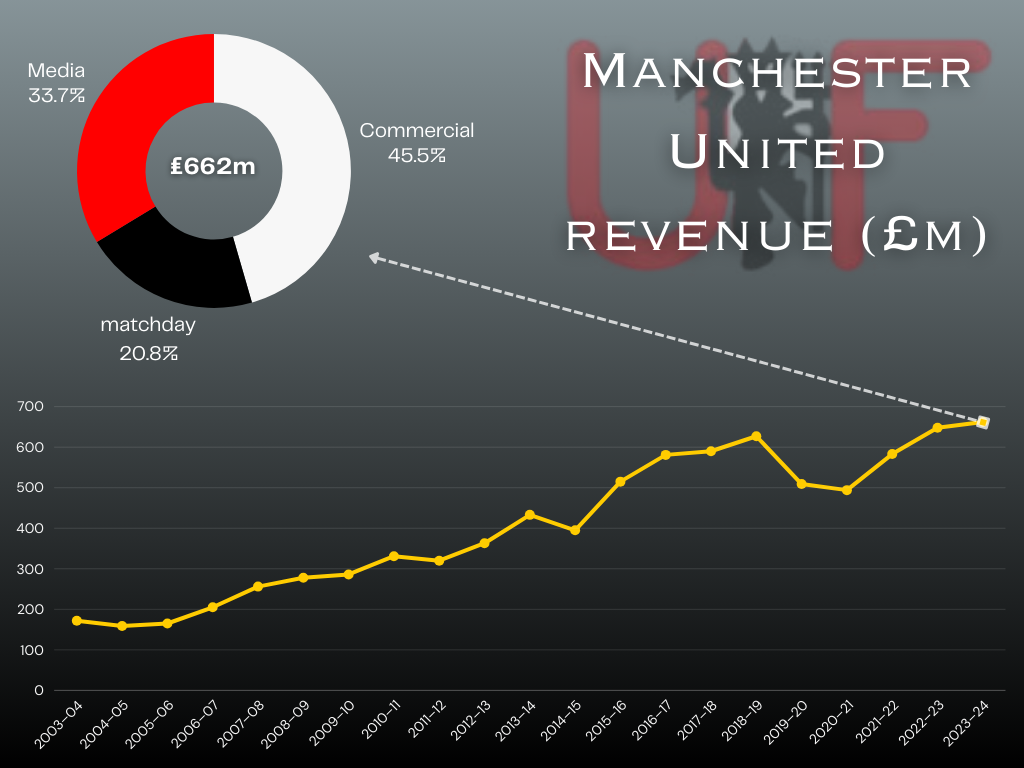
United’s revenue in 2023-24 stood at £662m, a new club record. They made a loss of £131m in the same period.
In their equivalent financial year, the bakery chain Greggs registered revenues of £1.8bn and a profit of £74m. B&M Bargains, the discount retailer, turned over £5.5bn and expects profits of £629m in 2024-25.
When it comes to other sports-adjacent brands, who might be a fairer comparison, the gap between football clubs and high street brands is even more stark.
JD Sports’ revenue was £10.4bn in its last reporting period. It expects profits of almost £1bn this year. Even sportswear brands like Fila, Under Armour, and Reebok earn several times what United do annually.
Other more sophisticated financial metrics such as EBITDA (earnings before interest, tax, depreciation and amortisation) reflect the same disparity.
So while United have the brand profile and potential customer base to rival any company in the world, they – and indeed all other football clubs – underperform when it comes to monetising their fans.
To United supporters who have just seen ticket prices rise sharply in a move that is impossible to justify in terms of performances on the pitch in recent months and years, it might not seem that way.
| Position | Team | Played MP | Won W | Drawn D | Lost L | For GF | Against GA | Diff GD | Points Pts |
| 7 |  Nottm ForestNottingham Forest Nottm ForestNottingham Forest | 12 | 5 | 4 | 3 | 15 | 13 | 2 | 19 |
| 8 |  Aston VillaAston Villa Aston VillaAston Villa | 12 | 5 | 4 | 3 | 19 | 19 | 0 | 19 |
| 9 |  FulhamFulham FulhamFulham | 12 | 5 | 3 | 4 | 17 | 17 | 0 | 18 |
| 10 |  NewcastleNewcastle NewcastleNewcastle | 12 | 5 | 3 | 4 | 13 | 13 | 0 | 18 |
| 11 |  BrentfordBrentford BrentfordBrentford | 12 | 5 | 2 | 5 | 22 | 22 | 0 | 17 |
| 12 |  Man UtdManchester United Man UtdManchester United | 12 | 4 | 4 | 4 | 13 | 13 | 0 | 16 |
| 13 |  B’mouthBournemouth B’mouthBournemouth | 12 | 4 | 3 | 5 | 16 | 17 | -1 | 15 |
| 14 |  West HamWest Ham West HamWest Ham | 12 | 4 | 3 | 5 | 15 | 19 | -4 | 15 |
| 15 |  EvertonEverton EvertonEverton | 12 | 2 | 5 | 5 | 10 | 17 | -7 | 11 |
| 16 |  LeicesterLeicester LeicesterLeicester | 12 | 2 | 4 | 6 | 15 | 23 | -8 | 10 |
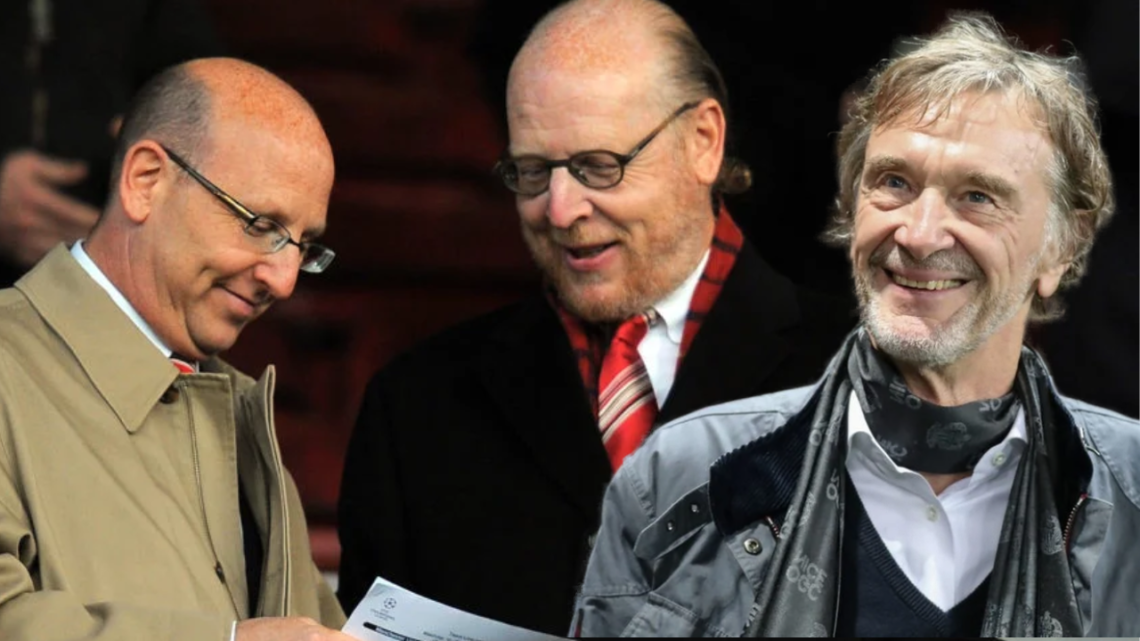
But the reality is that the Glazer family need United’s revenue and profit to appreciate in order to continue to take dividends.
Sir Jim Ratcliffe and Ineos’ approach is less cynical. Their aim is for United to operate a surplus to give Ruben Amorim and Dan Ashworth headroom under PSR for recruitment and retention purposes.
But either way, the impact on fans is the same.
If United do indeed have 1.1 billion potential customers worldwide, that means they generate just over 50p from each on an annual basis. Increase that figure even by a fraction and the yield is huge.
Matchday income is a key focus area, with plans to either rebuild Old Trafford or move to a new stadium expected to double matchday income in the long run.
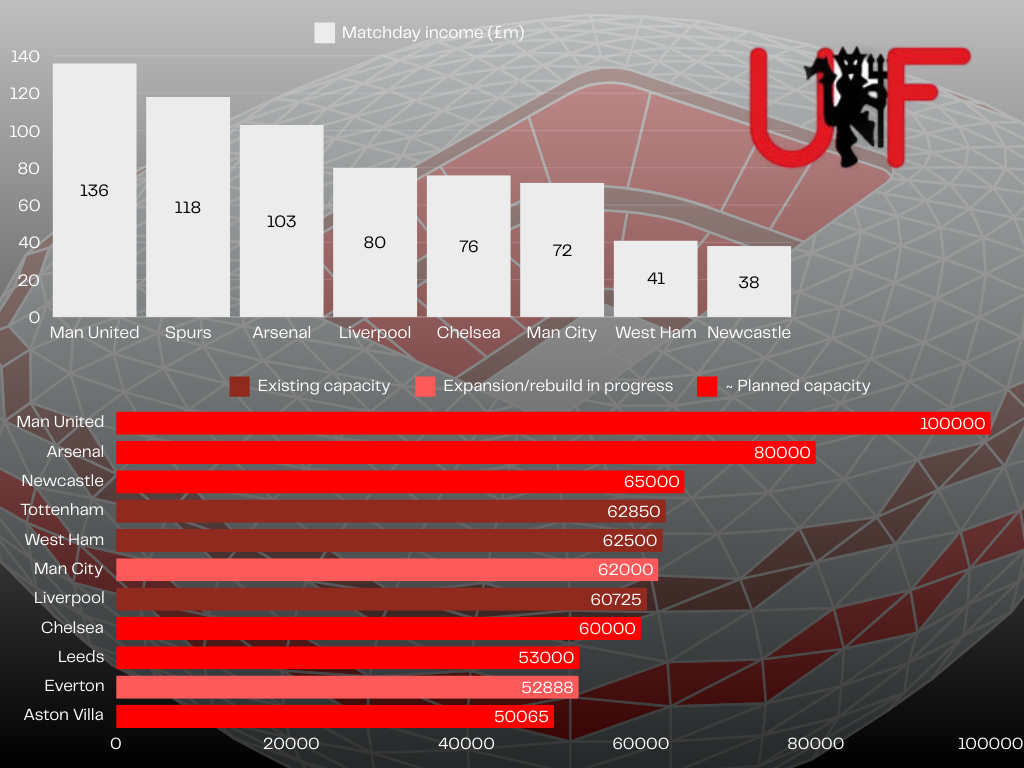
But bricks-and-mortar capital expenditure projects come at a huge cost and gains take years to realise.
Commercial income is a more agile revenue stream, although United’s growth in this area has been slow compared to other Big Six clubs in recent years.
United’s third main income stream, media revenue, is considered by many to be largely static, with deals negotiated by UEFA and the Premier League rising incrementally but not in huge jumps.
News this week suggests that a quantum leap in this department may now be coming into sharper focus.
- READ MORE: Finance expert predicts third billionaire could buy Man United stake in trio with Ineos and Glazers
Premier League to launch new in-house media service – Man United have been asking for it for years
In 2020 during the Covid pandemic, Man United, arch rivals Liverpool, and EFL chairman Rick Parry teamed up to launch Project Big Picture.
While the initiative was not strictly a breakaway league like the European Super League, it did propose a radical restructuring of English football.
Documents seen by United in Focus show that one of the proposals put forward by United and Project Big Picture’s co-authors wanted clubs to be able to sell a portion of their own media rights.
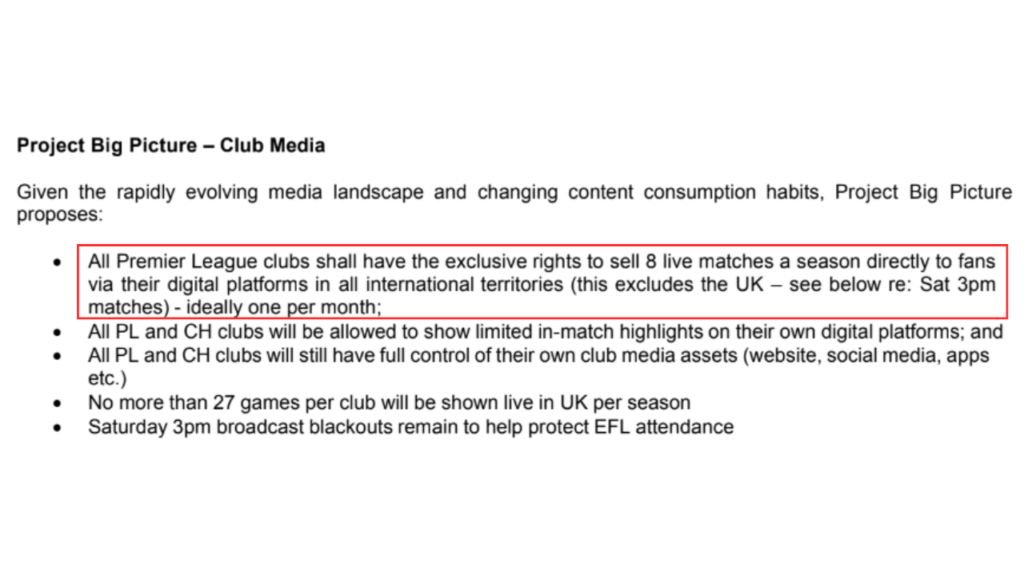
Essentially, the Glazers and then-chairman Ed Woodward wanted to cut out the middle men – the Premier League and Sky Sports – and stream some of their matches direct to fans for a PPV fee.
This, they think, can multiply their TV income by an order of magnitude, with United of the opinion that the Premier League’s distribution system does not reward them sufficiently given their global appeal.
The ambition didn’t die with the failed Project Big Picture either.
In their annual accounts released in September 2021, the pre-amble signed off by the Glazers again spoke of wanting to sell their own rights.
That was just a few months after the European Super League plot, wherein United and their fellow conspirators also included a provision to sell their own media rights.
In the latest developments, the Premier League appears to be warming to the idea of a direct to consumer service themselves.
At a shareholder meeting last Friday that was dominated by Man City’s challenge to the Premier League’s commercial rules, the reveal that they intend to launch an in-house media service went almost unnoticed.
From 2026-27, the Premier League will take its international media rights direct to consumers, likely via a Netflix-style app.
At present, the domestic rights – i.e., those owned by Sky Sports, TNT Sports, and Amazon Prime – are expected to continue in the traditional manner.
But given that the value of international rights now exceeds the UK TV deal, this is a major step in the right direction for the Glazers, who believe this model could be far, far more lucrative in the long run.
United could earn billions from TV rights revolution
So how much could United actually earn from a streamlined media chain?
Speaking on talkSPORT, former Crystal Palace owner Simon Jordan forecasted that the Premier League could theoretically quadruple their annual media earnings up to £12bn.
“I’ve been talking about this for three or four years,” he said.
“If you build your own platform and charge 100m people around the world £9.99 per month, which is no great shake in terms of cost, you’d be generating £10bn or £12bn per year.
“That is even before you get your advertising revenue. So there is an argument that the Premier League should be getting off its backside and moving through the gears.
“There is no doubt that Sky have taken football to a different level, but their time is beginning to go into the past.”
Analysis from football finance expert and author of the Vanity, Sanity and Reality newsletter Greg Cordell shows that the £3bn clubs currently receive from the Premier League is split on a 1.78 ratio.
Over a four-year rights cycle, that would mean United’s broadcast deal would be somewhere in the region of £2.4bn, assuming they are competing in and around the top six in that period.
And that is a conservative estimate which, as Jordan points out, would not include advertising revenue.
That would be transformative for the club.
For context, £2.4bn would be more than they have earned from all media sources combined (including the Champions League rights) since 2001.
Overnight, it would supersize United’s transfer and wage budget and likely make them profitable for the long term.
That in turn would increase their enterprise value and their appeal as a business proposition.
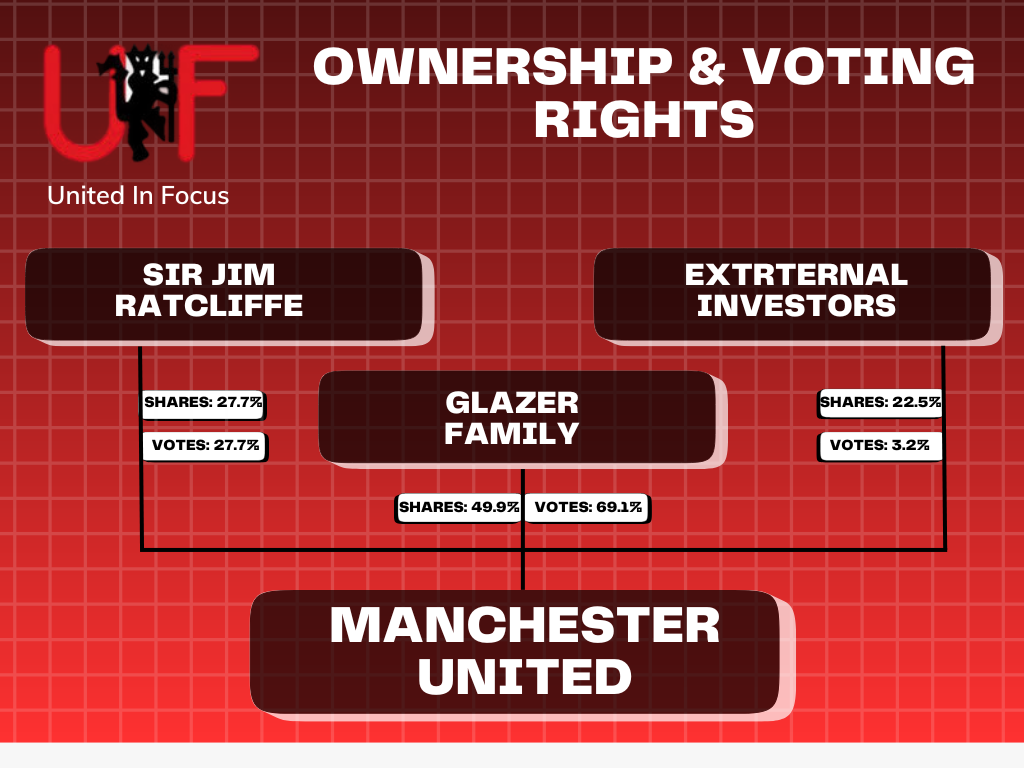
It could even open the door for the Glazers, who remain the largest shareholder faction at the club, to finally cash in and leave the club.
Receive a digest of our best United content each week direct to your mailbox