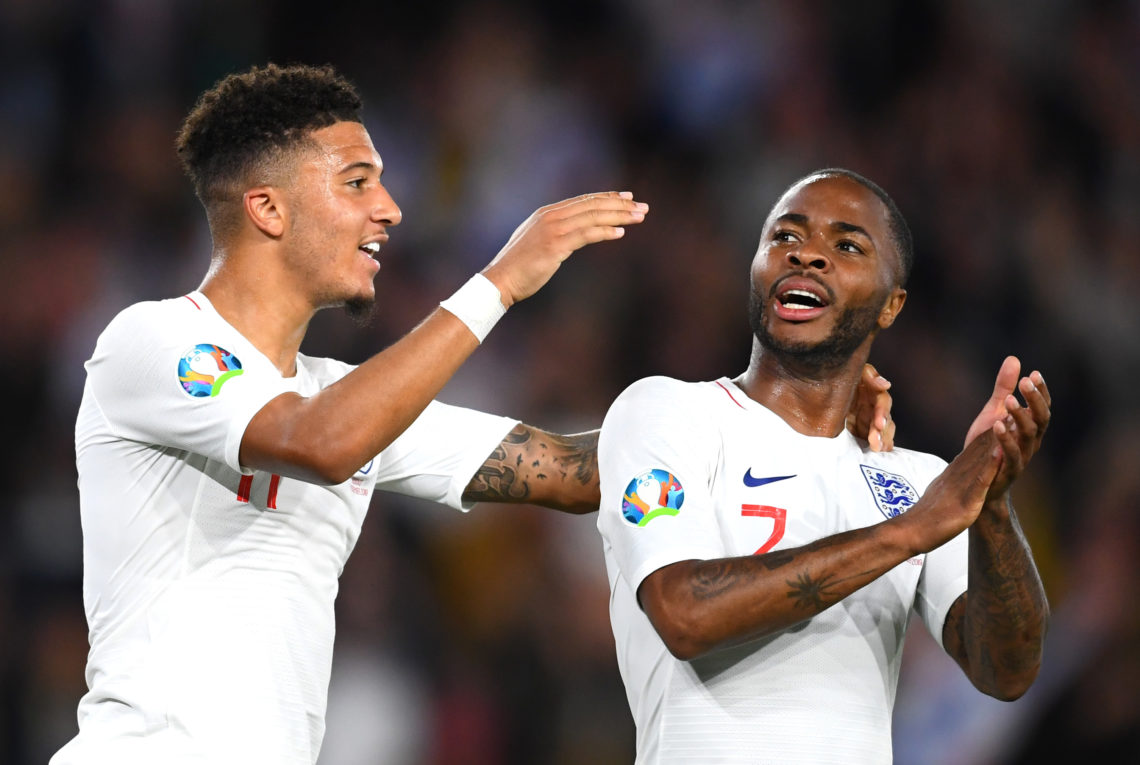


Raheem Sterling’s transfer to Manchester United is not a story that anyone would have seen coming at the start of the transfer window.
At the start of the window, Raheem Sterling was coming off a great season with Chelsea, Jadon Sancho had been reintegrated into the Manchester United squad, and a winger was the lost position on United’s agenda.
That’s how quickly things change in football and now, the only way for Manchester United to get rid of Jadon Sancho might be to get Sterling in.
Raheem Sterling to Manchester United will be history-making, but a swap with Chelsea will be particularly attractive to the club due to a piece of financial trickery involved, as financial expert and GRV Media’s Head of Football Finance and Governance Content, Adam William explains.

Financial trickery in Raheem Sterling-Jadon Sancho swap
There are currently two options on the table for Sancho’s United exit- a Juventus loan where United cover a portion of his wages, while also facing the prospect of him returning next season if the buy clause is optional.
Second is a move to Chelsea where Raheem Sterling, five years older and on higher wages, moves to Old Trafford and Sancho goes the other way.
On the surface, Juventus option looks the ‘less worse’ of the two as ultimately, it’s profit for United if they pay less wages and he spends a year of his contract elsewhere.
However, a financial wrinkle might just turn United’s head because the swap with Chelsea has an element of financial trickery to it.
Adam Williams says there is a big reason why the two clubs might prefer to exchange players but in separate deals instead of, say, a straight swap like Alexis Sanchez-Henrikh Mkhitaryan under Jose Mourinho.
He said: “We saw a flurry of these quasi-swap deals with two players exchange in separate deals for roughly equivalent value before the 30th June PSR deadline. Why? Because it gives both sides of the transaction a short-term boost.
“When you sign a player, his fee is amortised over his contract length up to a maximum of five years for PSR purposes.
“Sancho signed for United for £73m in 2021 on a five-year deal, so has two years remaining on his contract. To figure out his amortised book value, you divide £73m by five, which is £14.6m, and multiply that by two to give you £29.2m.
“You have to subtract that figure from whatever fee it is you sell him for, and it is the resulting figure that counts towards your PSR calculation.
“However, you get whatever that figure is upfront added to your PSR calculation. If the profit on the sale is £10m, you get £10m extra PSR capacity.
“When you sign a player on the other hand, only one year of his amortised cost comes out of your PSR capacity upfront. The rest is amortised over the remaining four years.
“So clubs can swap two players in separate deals for exactly the same fee and yet get 80 percent more PSR capacity in the current financial year.
“That’s an oversimplification, but that’s why United and Chelsea – both of whom are struggling in terms of PSR after years of profligacy – would consider a quasi-swap deal involving Sancho and Sterling.
“It’s not a free hit. You still have to bear the full cost of the deal over the remaining four years. Then, of course, there are wages to consider. But it can help clubs who need PSR headroom in the short term.”
Cost of doing business?
Ineos’ new-look executive team have a 100% hit rate in the transfer window so far with all the departures and arrivals proving to be popular with the fans.
- READ MORE: Manchester United confirmed signings, transfers in, out, loan exits, releases for 2024/25
Therefore, Sterling is the first name that has generated reservations from the fans and this explanation is unlikely to calm those down.
As Williams explains, doing this deal might give United short-term breathing space, but they’ll be lumbered with the wages of a soon-to-be 30-year-old Sterling with no clear role in the current United squad.
On the other hand, Sancho, at 24, not only has resale value, but there’s a chance he flourishes at Chelsea, the signs of which he showed at Borussia Dortmund too.
Ultimately, transactions done with the key purpose being financial rather than sporting consideration rarely end well, just ask Barcelona and their infinite levers.
United might consider this as a cost of doing business right now as they seem determined to sell Sancho, but it could bite them back in the long run.
This is the first deal under the new regime that is attracting intense scrutiny and rightly so.
Receive a digest of our best United content each week direct to your mailbox