


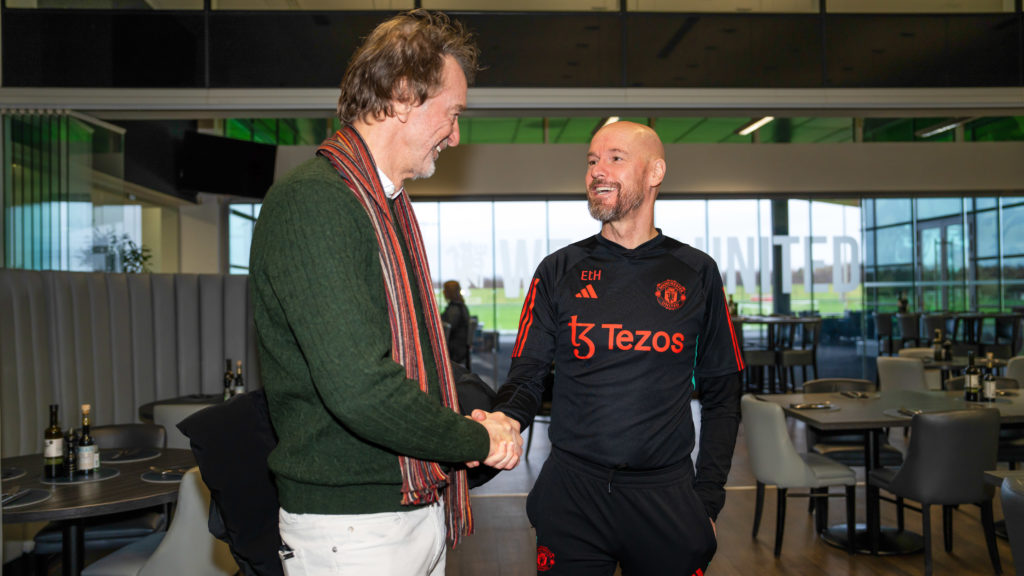
Just over six months into his Man United reign, Sir Jim Ratcliffe is set to learn the outcome of a case that could transform how the club operates and competes in English football.
Ratcliffe, 72, has been a disruptor so far in his time at Old Trafford, enacting sweeping changes in nearly every department behind the scenes – both sporting and corporate.
The Ineos CEO has also spent £10m to lay off hundreds of staff in a move clinically referred to as ‘headcount rationalisation’ in United’s latest accounts.
That initiative has been markedly less popular, but the new operational regime insist that it is necessary to find efficiencies within a club structure groaning under the weight of years of Glazer negligence.
At the other end of the spectrum in terms of its reception among supporters are the fast advancing plans to either expand or replace Old Trafford.
Proposals to build a 100,000-seater stadium in one of the biggest regeneration projects of all time would transform the club’s finances, both in terms of the revenue it would generate and the debt burden.
In the era of PSR (Profit and Sustainability Rules), this would be a seismic moment.
United only narrowly avoided breaching Premier League PSR for 2023/24 because of the £40m worth of losses they attributed to Covid.
Sentiment towards PSR has soured in recent years, but United – as a club that generates titanic revenues and is to some extent insulated from failure by the structure – have historically defended the system.
However, under Ratcliffe, the club’s position is somewhat opaque.
Ratcliffe has said that he believes over regulation could kill the Premier League, highlighting: “We’ve got more accountants than we’ve got sporting people at Manchester United.”
And if the chemicals billionaire wants to take a firmer stance, the opportunity is set to present itself in the form of an announcement on the future of Premier League spending regulations in the next few days.
Man City’s sponsorship case could transform Man United’s financial environment
The Premier League’s case against Man City for 115 alleged financial offences and non-compliance with PSR began last week.
It has the potential to blow football wide open.
But another case that could theoretically be just as consequential has also been heard by the Premier League and, according to industry publication The Lawyer, its outcome will be announced this week.
In what is widely seen as a counterpunch to the 115 charges hearing, City have sued the Premier League over their implementation of its associated party transaction (APT) rules.
United’s rivals want to overthrow the APT rules, which are ostensibly designed to ensure that every commercial deal signed by Premier League clubs is done so at a fair market price.
The aim is to stop club owners – and particularly state-owned clubs like Man City and Newcastle – from striking artificially inflated sponsorship deals in order to circumvent PSR.
If City’s challenge is successful, it would amount to a complete rewiring of the PSR system, as the current three-year £105m loss limit would become practically meaningless.
Why does this matter for Man United?
Because, in theory, it would allow Ineos to spend whatever they like on recruitment and retention so long as they pump the money in via sponsorship.
It would essentially make the Premier League a free market, where there would be no curbs on spending.
The combined net worth of the Glazers and Ratcliffe is an estimated £20bn, second only to Newcastle United’s Saudi paymasters on paper.
If the Premier League devolves into a simple arms race between billionaire-backed clubs, United have the financial firepower to outspend nearly every rival.
Significantly, however, it would also open the door for more Gulf state investment in the Premier League, which in turn poses an existential question about the future of football.
What will be the outcome of the APT case?
While nothing can be forecasted with any certainty, most analysts suggest that the Premier League are likely to fend off City’s challenge to the APT rules.
And in another procedural quirk, it has emerged that there is no clause in the Premier League’s rules that means they are obliged to announce the outcome at all.
However, with clubs set to meet today for a set of periodic governance talks, we will learn the outcome one way or another.
Leicester City’s successful appeal, despite admitting to breaching the Premier League’s £105m PSR loss limit, highlights that in these cases, one can never say never.
Speaking to Bloomberg about the APT case earlier this year, Ratcliffe said: “I can understand why they are challenging it,
“You can understand why they would say that they want an open market, a free market.
“The Premier League is probably the most successful sporting league in the world, certainly the most successful football league in the world.
“And we have this expression in northern England: ‘If it ain’t broke, don’t fix it.’
“If you start interfering too much, bringing too much regulation in, you finish up with the Manchester City issue, you finish up with the Everton issue, you finish up with the Nottingham Forest issue. On and on and on.
“If you’re not careful the Premier League is going to finish up spending more time in court than it is thinking about what’s good for the league.
“We have got the best league in the world, don’t ruin that league for heaven’s sake.”
Receive a digest of our best United content each week direct to your mailbox