


Profit and Sustainability Rules (PSR) have delivered neither profit nor sustainability for Manchester United, just as the previous system – Financial Fair Play – made football’s ecosystem anything but fair.
The system in its current form isn’t working for anyone. Man United had their accountants operating at full throttle to dodge a PSR breach in 2023-24 and sales are needed to fund a root-and-branch revamp of the squad this summer.
It’s a familiar story for an increasing contingent of Premier League clubs.
Everton and Nottingham Forest are so far the only sides to have been penalised for breaching PSR, while Leicester City escaped on a technicality earlier this season. But Newcastle United, Aston Villa and – despite some very creative accounting making them seem bullet-proof – Chelsea have had to revise their business plans because of Profit and Sustainability Rules.
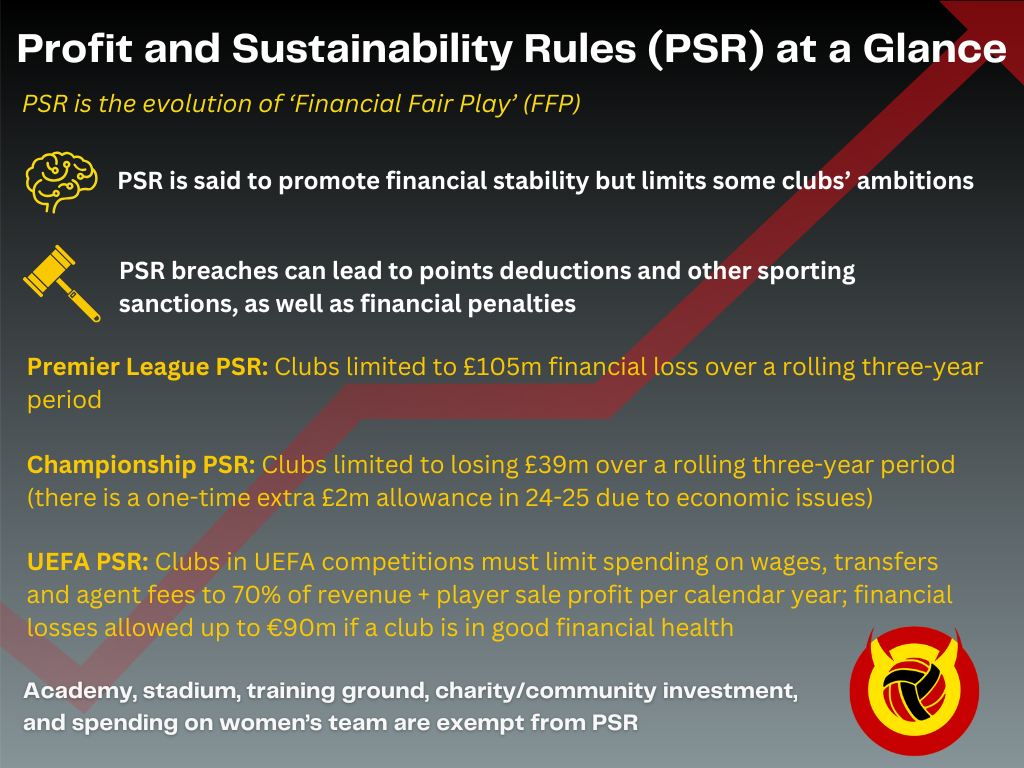
In football finance, retail therapy simply isn’t what it used to be.
- READ MORE: ‘Too much…’ – Matheus Cunha’s emotional admission after Man United were warned about Wolves star
Man United must be careful what they wish for with PSR
As far as Sir Jim Ratcliffe and the Glazers are concerned, the sentiment towards PSR at Old Trafford is mixed.
Ratcliffe has called plans to introduce an anchoring system wherein clubs would be limited to spending a multiple of what the Premier League’s bottom-placed club earns in TV money “absurd.”
As a free marketeer, Brexit advocate and resident of tax-free Monaco, the Ineos billionaire’s reflex is to champion less regulation, not more. See also: the 72-year-old’s positions on the proposed independent watchdog for English football, Manchester City’s challenge to the Premier League’s APT rules, and the internecine lawfare that is currently dominating the domestic game.

However, while a more libertarian approach to PSR might be in United’s short-term interests, it’s almost certainly a case of better the devil you know for the Red Devils.
Yes, it’s frustrating being constrained in the transfer market and banking on a backdoor route to Champions League qualification via the Europa League to comply with nebulous spending rules, but it would be a whole lot worse if spending was not indexed to profit and revenue. United would be overwhelmed by competitors rolling in sovereign wealth and private equity money.
The Glazers and Ratcliffe are worth about £25bn collectively. Setting aside the fact that the Glazer family aren’t interested in putting their own cash into the club, that’s the kind of money that the Saudi Public Investment Fund (Newcastle), Silver Lake (Manchester City) or Clearlake (Chelsea) barely bother getting out of bed for.
United, on the flipside, can and should be sustainably run.

With plans to build a new stadium to replace Old Trafford and a peerless commercial brand, the club will – in time – have more PSR headroom than just about anyone else.
But the macroeconomic realities of football and hypothetical financial modelling aren’t of any concern to Ruben Amorim at the moment – he’s got a super tanker to turn around.
Manchester United could be forced into PSR workaround ahead of summer transfer window
Sleights of hand, jigger-pokery, loophole exploitation – whatever you want to call it, it’s rife among clubs desperate to carve out breathing space under PSR.
Chelsea have been the main culprits here. First they, used ultra-long contracts to amortise signing fees over an extended period, though that loophole has now been closed.
Ahead of last summer’s PSR deadline when the monitoring period rolled over, they were also among the teams to use quasi-swap deals, with players traded between clubs in separate transactions for roughly equivalent fees so as to create a short-term player trading profit. Amortisation strikes again.

Now, they have moved onto intra-company asset sales – effectively taking money out of one pocket and putting it in the other.
Chelsea have sold two hotels, a cark park, and a portion of their training ground to sister companies to create artificial PSR profits worth £100m-plus in recent years. However, the biggest intra-company sale of all? The Women’s team.
The Blues banked an artificial PSR profit of £200m by selling the Women’s team to themselves in the last financial year, which allowed them to turn a profit in 2023-24 and meet Premier League spending rules despite gigantic, historic operating losses.
Now, according to one football finance expert, United may consider doing the same to get within the £105m allowable loss threshold next season.
The latest analysis from Stefan Borson, a former advisor to Manchester City, suggests that United have likely escaped a breach under Premier League and UEFA rules this season.
But next season’s compliance could rest entirely on whether United, who beat Athletic Bilbao 3-0 night in San Mames last night, have European football next season.
‘PSR, however, would undoubtedly be a challenge if United have no Europe at all in 25/26. Sir Jim Ratcliffe may well be looking at the sale of the Women’s team in that scenario,’ he writes.
- READ MORE: Real Madrid now seriously considering signing player Manchester United sold for just £5m last year
How much is Man United’s Women team worth?
While the Premier League is yet to close the intra-company sales loophole, United wouldn’t have carte blanche to sell the Women’s team to themselves at whatever price they like.
The Premier League is assessing the Chelsea sale for fair market value, a provision which is designed to prevent clubs from striking artificially inflated deals with owners to subsidise squad spending.
The £200m deal raised eyebrows among some, but Chelsea are currently in talks with a potential buyer of a minority stake whose investment they hope will justify the valuation.
United’s Women’s team has been nowhere near as successful as Chelsea’s. Indeed, victory over United Women at Leigh Sports Village last Sunday delivered a sixth successive Women’s Super League title for the Blues.
United Women won the FA Cup last season and are on course to finish 3rd in the WSL in 2024-25, though Ratcliffe has been accused of leaving them behind since his part-takeover in February last year.
“There’s only so much that you can do and our focus has been on the men’s team. If not, you get spread too thinly,” he said last year.
“We need to sort out the main issue – the men’s team. The women’s team is an opportunity. Women’s football is growing really quickly in popularity and size.”
Even if they are some way off the Blues on the pitch and in terms of investment, however, the United brand means that the Women’s team would be worth a similar amount as far as the fair market value assessment is concerned.
The business generated around £7m last year, less than Chelsea’s £11.5m. Using the same multiplier, that would make United Women worth £121m. The brand difference, however, likely makes up the gap.
Receive a digest of our best United content each week direct to your mailbox