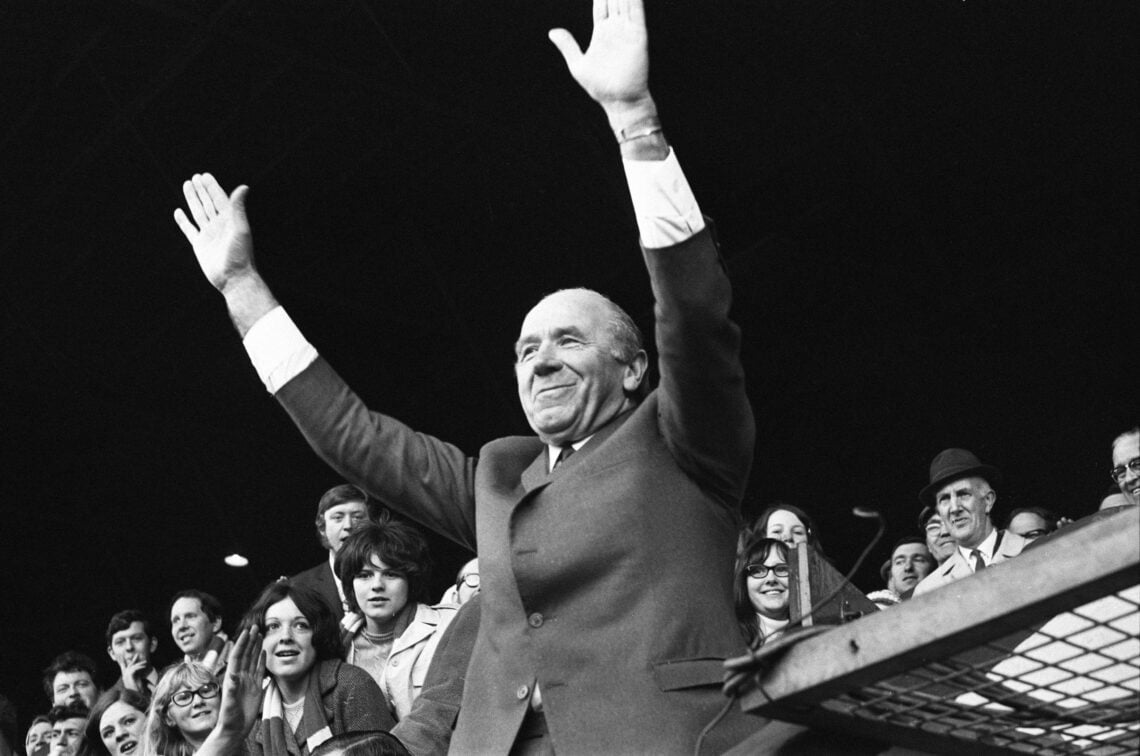


The Sir Matt Busby era transformed Manchester United, helping to establish the club as the biggest in English football.
The legendary Scottish manager was appointed after the Second World War, after rejecting the chance to manage Liverpool.
Sir Matt Busby met with United chairman James Gibson in February 1945 and had three non-negotiables in his blueprint to transform the Red Devils.
- Full control of team selection
- Leading training sessions
- Five-year security
The promise of job security allowed Busby time to commit to bringing through youth players, one of the keys to his success, a journey of triumph and tragedy.
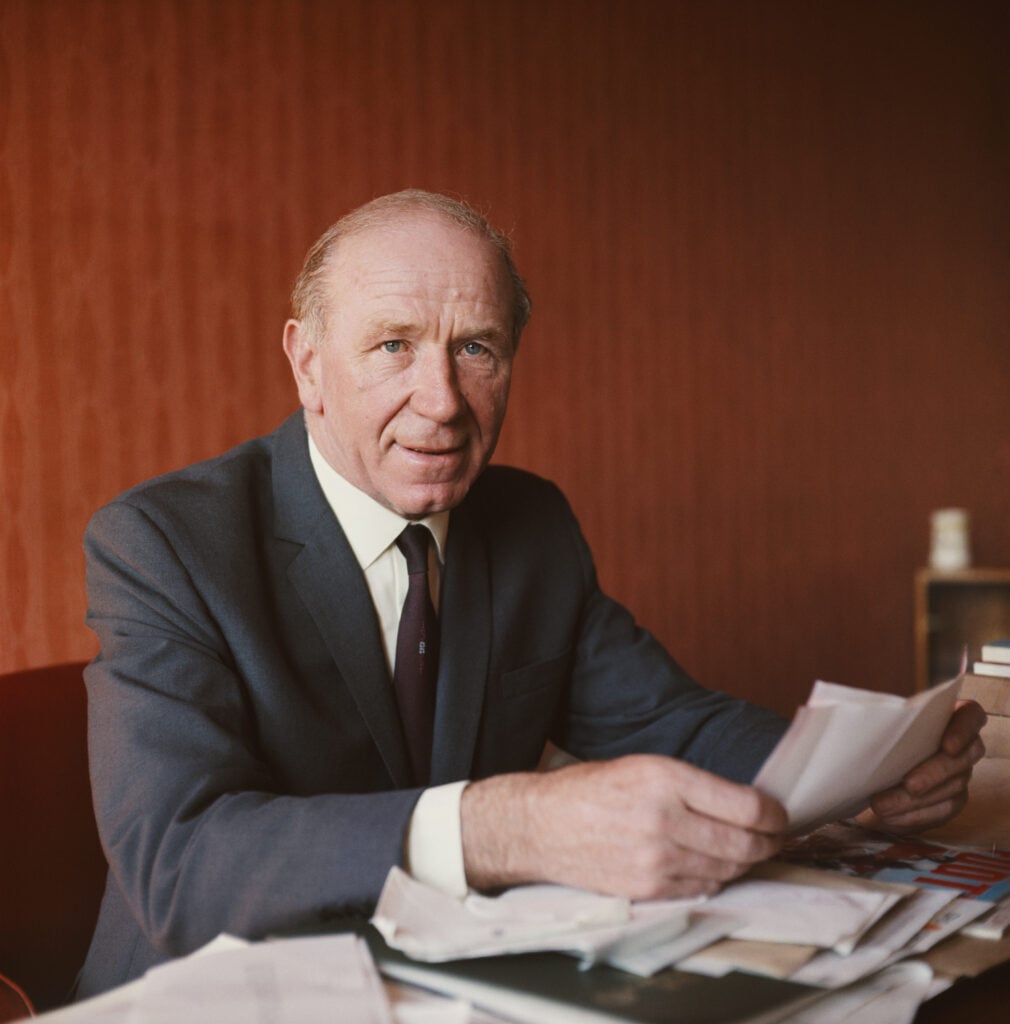
Here is a journey back into club history, the full season-by-season guide to the Sir Matt Busby era at Manchester United.
- Note – during this era, league results awarded a win with two points
1945/46
- Final Position: 4th in the Football League North
- FA Cup: Fourth Round – Eliminated by Preston North End
- Top Scorer: Jimmy Hanlon (15)
Manchester United began the post-war era playing at City’s Maine Road stadium after Old Trafford was bombed during the conflict.
The 1945/46 season saw United compete in the unofficial regional league set up, also known as the War League. The team put together an entertaining campaign, scoring 98 goals, finishing fourth, with the league won by Sheffield United.
United returned to competitive football in the FA Cup, played over two legs. Sir Matt Busby’s side defeated Accrington Stanley, before losing to Preston North End in the Fourth Round.
1946/47
- Final Position: 2nd
- FA Cup: 4th round – Eliminated by Nottingham Forest
- Top Scorer: Jack Rowley (28)
The first real season of the Sir Matt Busby era took place in 1946/47, with the reformation of the Football League, with Manchester United in the First Division.
United finished in second place, the club’s highest finish since winning the title in the 1910/11 season.
The club’s strong season was powered by prolific scorer Jack Rowley, who netted a total of 211 goals for the club in total – despite missing several years of his career due to the War.
United finished the season with a 6-2 win over Sheffield United, agonisingly finishing one point behind Liverpool, who Busby’s team had beaten 5-0 early in the season.
1947/48
- Final Position: 2nd
- FA Cup: Winners
- Top Scorer: Jack Rowley (28)
Another outstanding season from Jack Rowley was only enough for Manchester United to finish in second place again.
Manchester United were still playing home games at Maine Road, and during this season set the record for the highest ever attendance for a league match at the stadium.
More than 83,000 crammed in to see a 1-1 draw with eventual champions Arsenal in January 1948, with Rowley on the scoresheet. United consistently drew higher crowds than City did.
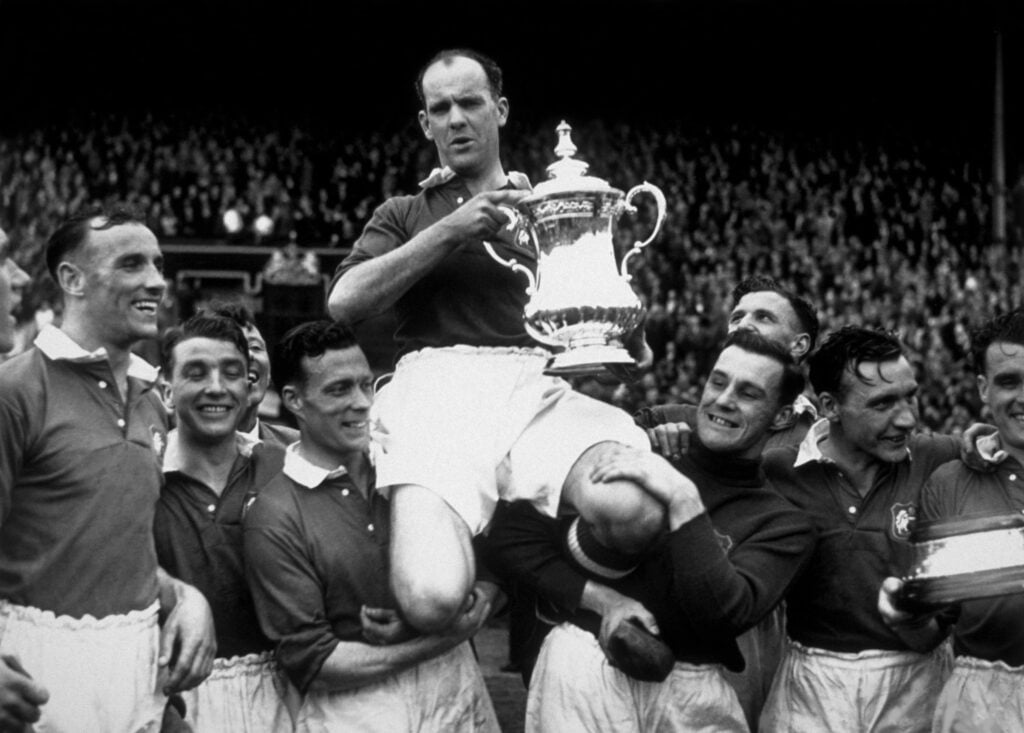
1947/48 was most memorable for Sir Matt Busby’s first ever trophy as manager, with United winning the FA Cup at Wembley. It was the first time the club had won the cup since the only previous success in 1908/09.
To reach the Final, United knocked out Aston Villa, Liverpool, Charlton Athletic, Preston North End and Derby County – with Stan Pearson netting a hat-trick in the semi-finals.
An attendance of 99,000 saw United defeat a Blackpool team led by Stanley Matthews and Stan Mortensen.
United had trailed 2-1 at half-time before coming back to win 4-2, with goals from Rowley (2), Pearson, and John Anderson. Captain Johnny Carey lifted the trophy, becoming the first Irish player to lift silverware for the club.
1948/49
- Final Position: 2nd
- FA Cup: Semi-finals – Eliminated by Wolves
- Top Scorer: Jack Rowley (30)
For the third season in a row, Sir Matt Busby’s team finished as First Division runners-up. This time it was Portsmouth who won the title, conceding only 32 goals.
United’s defence of the FA Cup went down to a semi-final replay after a 1-1 extra-time draw against Wolves in the first encounter. United lost the replay 1-0.
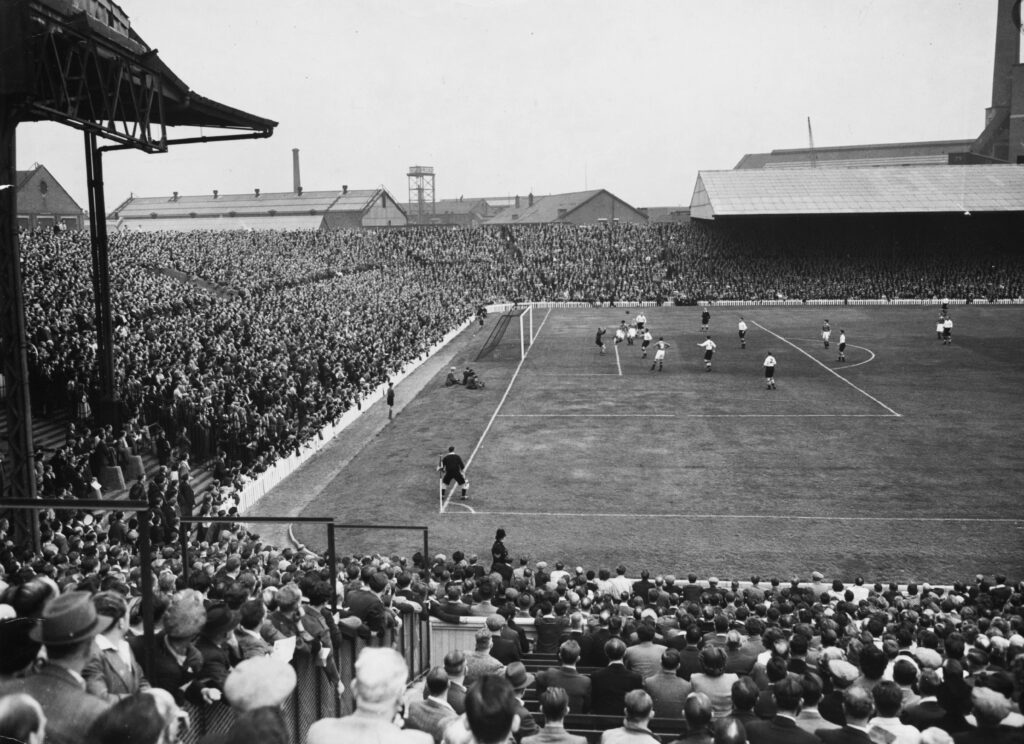
Busby’s team was built around his ‘Famous Five’ forwards Jimmy Delaney, Stan Pearson, Jack Rowley, Charlie Mitten and Johnny Morris. Each of them continued to play a key role in this campaign, with winger Mitten scoring 18, next behind Rowley’s 30.
Johnny Carey became the first ever Manchester United player to win the Football Writers’ Association Player of the Year Award.
1949/50
- Final Position: 4th
- FA Cup: Quarter-finals – Eliminated by Chelsea
- Top Scorer: Jack Rowley (25)
Manchester United finally returned to playing at Old Trafford for the start of the 1949/50 season, winning the first match back 3-0 against Bolton, via Mitten, Rowley and an own goal.
United had climbed to first place by March 12, with three successive wins including a 7-0 victory over Aston Villa, in which Mitten scored four.
But a disastrous end to the season saw United win only one of the final 10 games to slide to a disappointing fourth place. Portsmouth finished first again – their last ever league title.
In the FA Cup, United reached the quarter-finals by knocking Portsmouth out after a fifth-round replay – before losing 2-0 away to Chelsea.
1950/51
- Final Position: 2nd
- FA Cup: Quarter-finals – Eliminated by Birmingham City
- Top Scorer: Stan Pearson (23)
Another strong season for Sir Matt Busby’s side saw Manchester United finish second for the fourth time in five years.
Busby’s United played a game on Christmas Day, with 47,000 in attendance for a 0-0 draw with Liverpool. United then went to Anfield two days later and won 2-0.
United won eight of the final 10 games – but finished four points behind eventual title-winners Tottenham.
The FA Cup campaign featured wins over Oldham, Leeds and Arsenal before an away defeat to Birmingham City.
Two of the early ‘Busby Babes’, Mark Jones and Jackie Blanchflower both made their debuts this season.
1951/52
- Final Position: Champions
- FA Cup: Third round – Eliminated by Hull
- Top Scorer: Jack Rowley (30)
Champions at last! Sir Matt Busby finally won his first league title, in his sixth proper season in the First Division.
United sealed the title on the final game of the season with a 6-1 win over Arsenal, in which Jack Rowley netted a hat-trick. The Gunners had been just two points behind United heading into the last day showdown, with 53,000 in attendance at Old Trafford to see it.
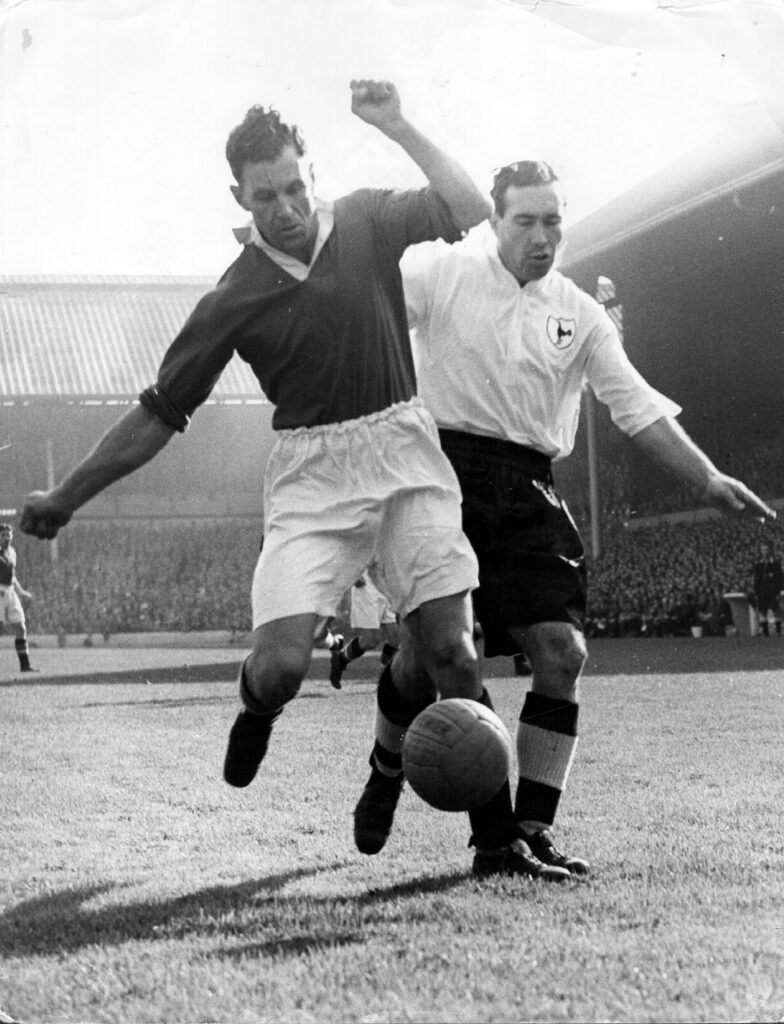
Rowley (pictured above) netted 30 goals in 41 games. This did not include his seven goals in a pre-season friendly win over US side Fall River All Stars, an 11-1 win.
United were still captained by defender Johnny Carey, who played 38 of the 42 league games, scoring three goals.
This was the peak of Busby’s first United side, who came so close to winning the title on four previous occasions, finally winning the league to shake off the pretender status.
1952/53
- Final Position: 8th
- FA Cup: Quarter-finals – Eliminated by Everton
- Top Scorer: Stan Pearson (18)
Manchester United’s defence of the league title did not go to plan, with the team finishing in eighth place, the lowest to date under Busby.
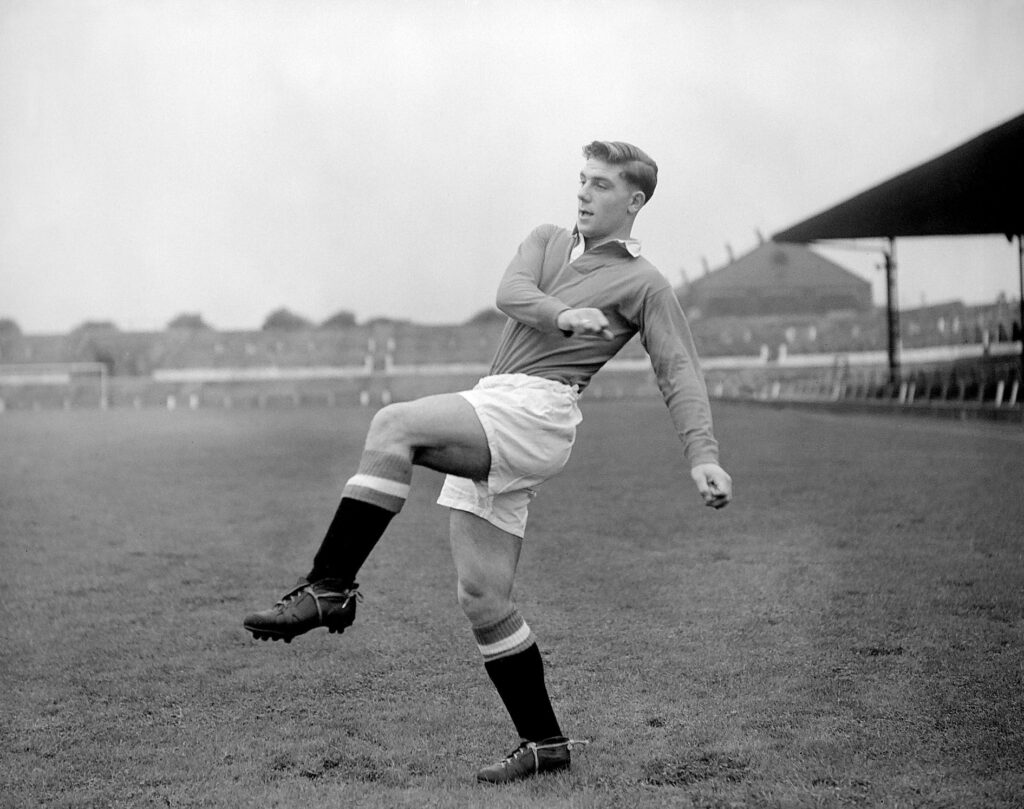
The 1952/53 season saw Busby look to usher in a new era, with 16-year-old Duncan Edwards making his debut for the club.
‘Busby Babes’ David Pegg and Dennis Viollet also made their first appearances for the club.
United did win the Charity Shield with a 4-2 win over Newcastle. The FA Cup campaign ended in the fifth round with a 2-1 defeat to Everton.
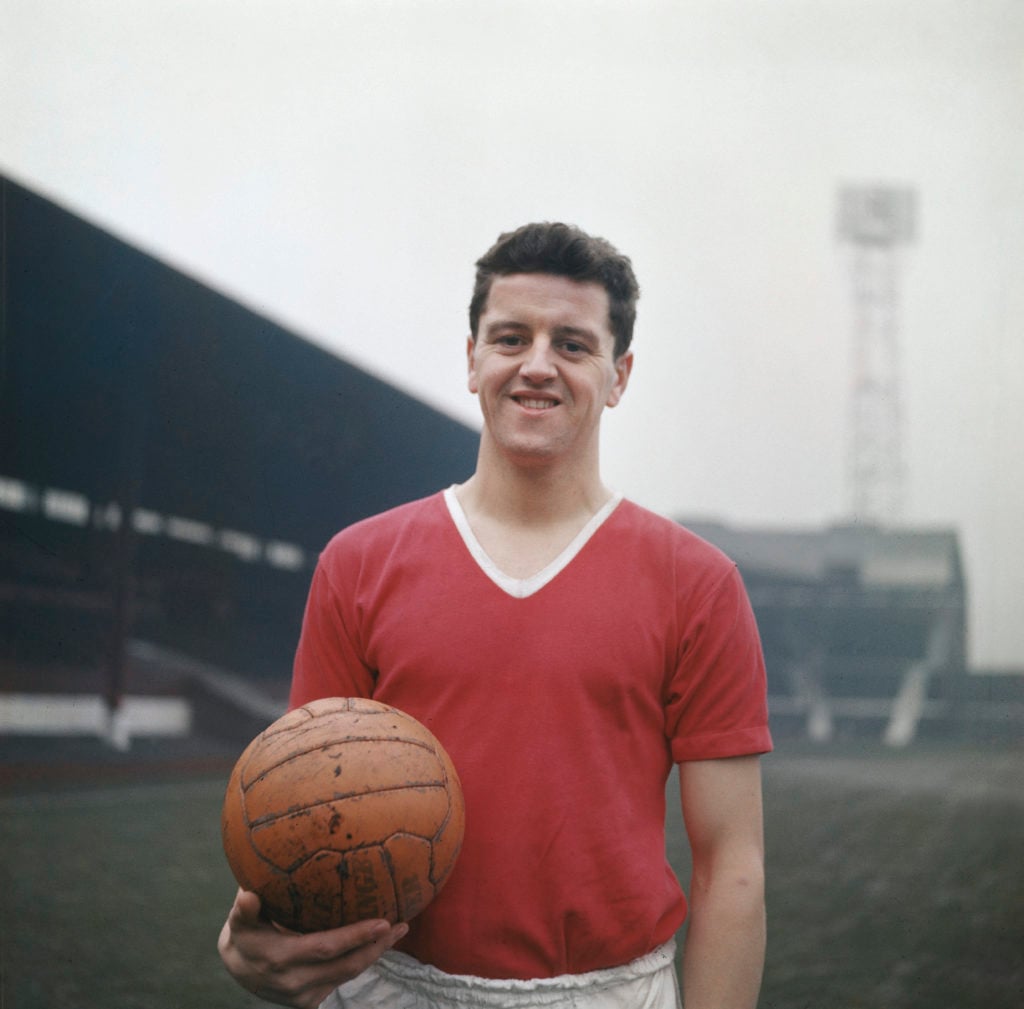
Stan Pearson finished as United’s top scorer, while Busby strengthened the team in April with a £29,999 signing of striker Tommy Taylor.
This season was the final campaign for veteran captain Johnny Carey, who retired at the end of the season.
1953/54
- Final Position: 4th
- FA Cup: Third round – Eliminated by Burnley
- Top Scorer: Tommy Taylor (23)
Tommy Taylor’s first full season for United saw him finish as the team’s top scorer with 23 goals.
United began the season poorly, failing to win any of the opening eight league games. A 4-1 win away at Middlesbrough was a turning point.
The team ended the campaign with 18 wins, finishing in fourth place, just nine points behind champions Wolves.
After scoring once the previous season, Dennis Viollet netted 12 goals in 1953/54, as he and Duncan Edwards began to really secure their spots in the team.
1954/55
- Final Position: 5th
- FA Cup: Fourth round – Eliminated by Man City
- Top Scorer: Dennis Viollet (21)
Despite a strong start with six wins in the opening eight games, Manchester United could only finish fifth in a tight campaign.
Busby’s team finished five points behind champions Chelsea, with a run of four losses in five games in February and March proving pivotal.
Busby’s next great side was still starting to take shape, with Viollet netting 21 goals and Taylor scoring 20. Four of Taylor’s goals came in a 5-2 win over Cardiff.
The pair combined spectacularly in a dramatic 6-5 away win over Chelsea, with Viollet bagging a hat-trick, Taylor two, and Jackie Blanchflower grabbing the sixth.
This was a transitional year for United, highlighted by Jack Rowley’s exit at the end of the season after 18 years at the club. The legendary striker signed off with eight goals in his final campaign.
1955/56
- Final Position: Champions
- FA Cup: Third round – Eliminated by Bristol City
- Top Scorer: Tommy Taylor (25)
Manchester United won the title for the second time in the Busby era, finishing 11 points clear of second place Blackpool. This was despite only winning three of the opening eight games.
With just two points for a win, the title margin was a sign of United’s dominance. It was the biggest title margin in English football since the 1899/00 season.
United’s procession towards the league title featured a 14-game unbeaten run to end the season. They also went the entire season unbeaten at Old Trafford.
The side showed that Busby’s squad building around his young players paid off. Tommy Taylor’s 25 goals was supported by another 20 from Viollet.
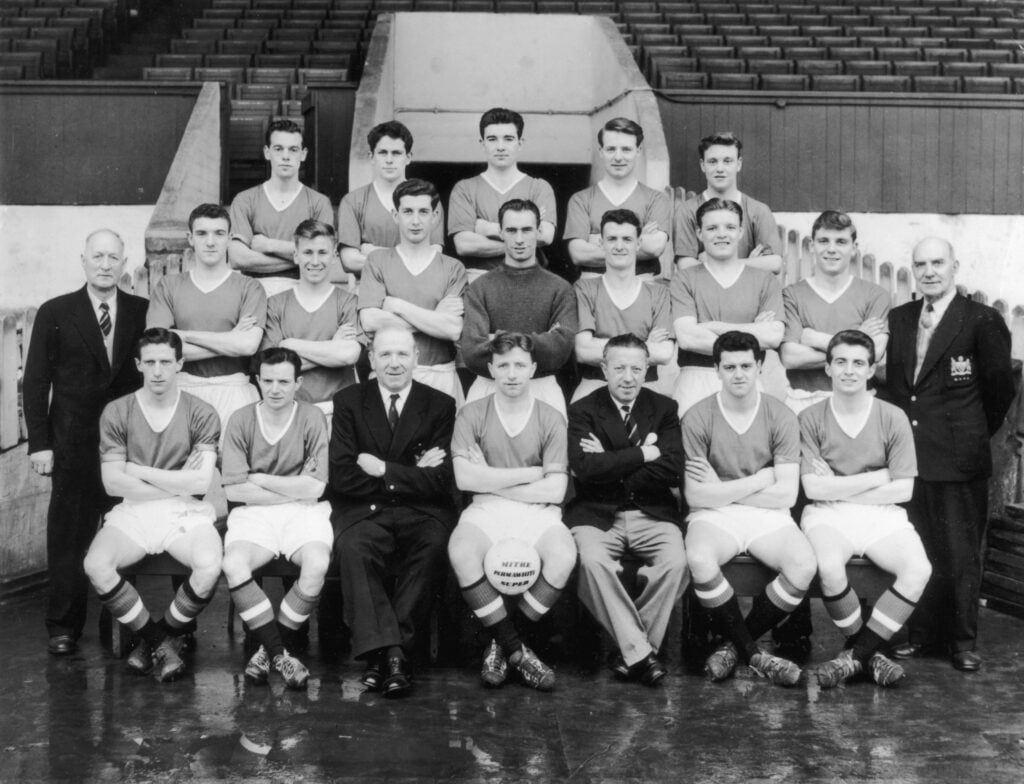
Ray Wood, Roger Byrne (now captain), David Pegg, Duncan Edwards, Eddie Colman and Johnny Berry all played key roles as regulars through the campaign.
1956/57
- Final Position: Champions
- FA Cup: Runners-up – Defeated by Aston Villa
- European Cup: Semi-finals – Defeated by Real Madrid
- Top Scorer: Tommy Taylor (34)
As league champions from 1955/56, Manchester United entered the European Cup for the first time, the start of a new adventure.
The European campaign began with a 12-0 aggregate win over Anderlecht, including a 10-0 second leg win that remains the club’s biggest ever win.
More than 75,000 fans packed Old Trafford to watch a 3-2 home win over Borussia Dortmund in the next round.
In the quarter-finals United had trailed Athletic Bilbao 5-3 from the first leg before winning 3-0 at Old Trafford, with Viollet scoring the tie-clinching goal in a 6-5 aggregate win.
United were undone by Alfredo di Stefano’s Real Madrid in the semi-finals, losing 5-3 on aggregate despite a creditable 2-2 home draw. Busby was offered a job by Real Madrid in the wake of United’s performance – and rejected the opportunity, The Telegraph reported.
In the league, United retained the title for the first time, with another dominant campaign with a eight-point winning margin. The team won five and drew one of the final six games, finishing in style.
The season was notable for Bobby Charlton making his debut for the club, he scored 12 goals in 17 appearances. This included a hat-trick in a win over Charlton.
Tommy Taylor enjoyed his best season yet with 34 goals, followed by Billy Whelan’s 33. Viollet was not far behind with 26.
In 1956, goalkeeper David Gaskell became the club’s youngest ever player at 16 years and 19 days, also becoming the club’s first ever substitute.
In the FA Cup, a crowd of 100,000 saw United defeated 2-1 in the Final at Wembley by Aston Villa, with Taylor scoring a consolation. Villa’s win set a record at the time for seven FA Cup wins.
With a league title, European Cup semi-final and FA Cup Final reached, this was the first time in history Manchester United had flirted with the Treble, a dream eventually fulfilled 42 years later.
1957/58
- Final Position: 9th
- FA Cup: Runners-up – Defeated by Bolton Wanderers
- European Cup: Semi-finals – Defeated by AC Milan
- Top Scorer: Dennis Viollet (23)
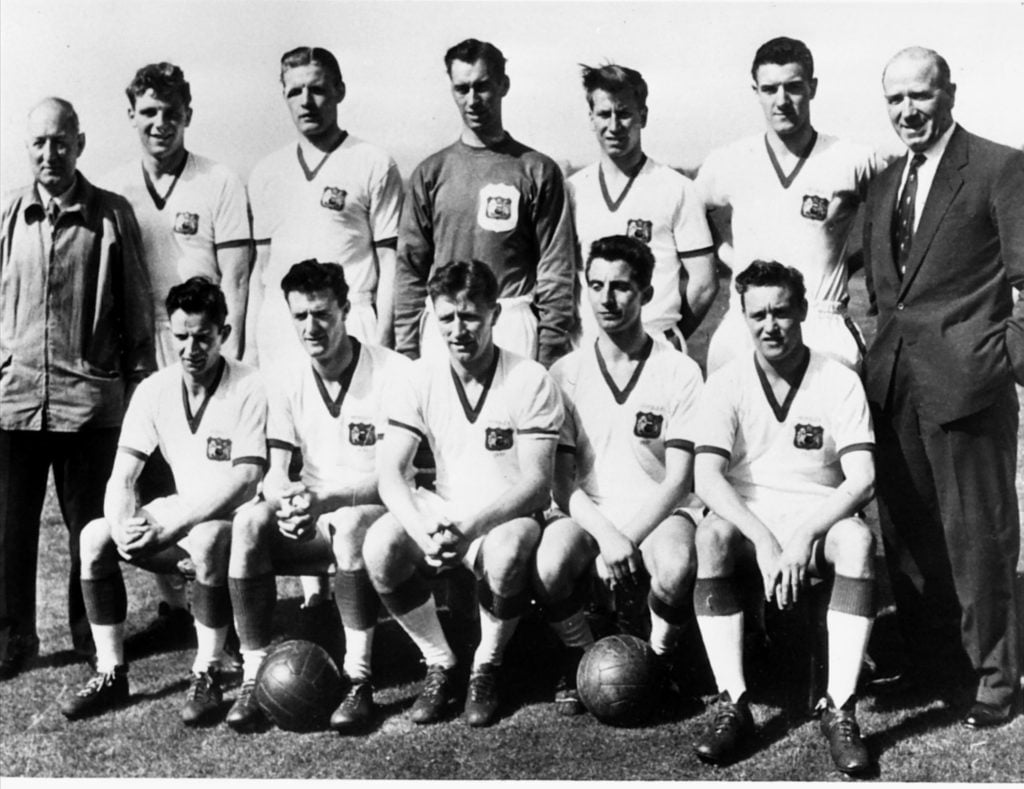
The 1957/58 season was overshadowed by the tragedy of the Munich Air Disaster in February 1958, which claimed the lives of eight players.
Tommy Taylor, David Pegg, Roger Byrne, Billy Whelan, Eddie Colman, Mark Jones, Geoff Bent and Duncan Edwards all died in the crash. United were travelling back from a European Cup quarter-final win against Red Star Belgrade.
15 more lives were lost in the tragedy, with 23 dead in total. Two of the team’s survivors never played a match again, Jackie Blanchflower and Johnny Berry.
The deaths left a devastating impact on the core of the Manchester United team, and also had a knock-on effect for England’s hopes of winning the 1958 World Cup.
Sir Matt Busby survived the plane crash and but was hospitalised for more than two months, and considered quitting management.
Jimmy Murphy took over as coach for the remainder of the season. He had not been on the plane due to his coaching commitments with Wales.
Remarkably, United beat AC Milan 2-1 in the European Cup semi-final first leg, before losing the second leg 4-0. The disaster likely denied a dream final between United and Real Madrid.
United’s final two league games before the tragedy were spectacular. The team defeated Bolton 7-2, with Bobby Charlton scoring a hat-trick. The team then beat Arsenal 5-4, with Taylor (2), Charlton, Edwards and Viollet on the scoresheet. The team only won one league game after the tragedy and finished in ninth place.
In the FA Cup, post-disaster United beat Sheffield Wednesday, West Brom and Fulham, before losing the Final 2-0 to Bolton. Just reaching the Wembley showpiece was a victory itself in impossible circumstances. Busby was able to attend the Final as a spectator.
The Telegraph reported that Real Madrid had offered to loan Alfredo di Stefano to Manchester United in the wake of the tragedy – but the move was blocked by the FA.
Feel free to leave your tributes to the Busby Babes and the lives lost in the 1958 Munich Air Disaster
If you were old enough to see the 1958 team, please share your memories / Younger readers, let us know what the team means to you…

1958/59
- Final Position: 2nd
- FA Cup: Third round – Defeated by Burnley
- Top Scorer: Bobby Charlton (29)
After agreeing to return to the dugout, it was testament to Sir Matt Busby’s character as well as his recruitment and managerial skills that he was able to lead Manchester United to a second placed finish in 1958/59. The team finished six points behind Wolves, and had even been top of the league in March.
Bobby Charlton led the way with 29 goals in all competitions, beginning the season with a hat-trick in a 5-2 home victory over Chelsea.
Fellow survivors Dennis Viollet contributed 21 goals and Albert Scanlon 16, while new signing Warren Bradley netted 12. United also paid a British record fee of £45,000 to sign forward Albert Quixall from Sheffield Wednesday.
1959/60
- Final Position: 7th
- FA Cup: Fifth round – Eliminated by Sheffield Wednesday
- Top Scorer: Dennis Viollet (32)
Dennis Viollet’s 32 league goals in 39 games for Manchester United in 1959/60 was a club record that still stands today. Cristiano Ronaldo’s 31 in 2007/08 came closest to matching him.
United were the highest scorers in the league with 102 goals, the first time any club had topped the century mark in the top flight.
The problem was that the team conceded 80 goals. This made for an entertaining formula – but not a successful one. United could only finish in seventh place.
1960/61
- Final Position: 7th
- FA Cup: Fourth round – Eliminated by Sheffield Wednesday
- League Cup: Second round – Eliminated by Bradford City
- Top Scorer: Bobby Charlton (21)
For the second successive season Manchester United finished in seventh place. United conceded 76 goals – still proving competitive by scoring 88.
This was the season future World Cup winner Nobby Stiles made his debut for United. He played 31 games in total, scoring twice.
Charlton’s 21 goals were supported by 20 from young forward Alex Dawson. Viollet scored 16 and Quixall contributed 15 of his own.
United played in the League Cup for the first time, defeating Exeter City before losing to Bradford City. The club did not enter the competition again until 1966/67.
The FA Cup campaign went poorly, with United defeated 7-2 by Sheffield Wednesday in a fourth round replay.
To highlight the unpredictable season, United won 6-0 twice in the league against Burnley and Chelsea, beat West Ham 6-1, and lost 6-0 to Leicester City.
1961/62
- Final Position: 15th
- FA Cup: Semi-finals – Eliminated by Tottenham
- League Cup: Did not enter
- Top Scorer: David Herd (17)
Ahead of the new season Manchester United signed David Herd from Arsenal for £35,000. Herd had netted 107 goals for the Gunners, and went on to score 145 for the Red Devils.
Herd made an immediate impact in his first season, finishing as top scorer for United with 17 goals.
Without him, United could have been in trouble. A poor league campaign saw United record a lowest ever finish under Busby to date in 15th, finishing only seven points clear of the relegation zone.
The season still featured big victories, a 6-3 win over Forest, 6-1 vs Blackburn and 5-0 over Ipswich. But these big wins were few and far between.
A stretch of eight defeats and two draws in 10 games between October and December cancelled out a relatively strong start to the season.
Busby made a controversial mid-season decision to sell Dennis Viollet to Stoke City for £25,000.
1962/63
- Final Position: 19th
- FA Cup: Winners
- League Cup: Did not enter
- Top Scorer: Denis Law (29)
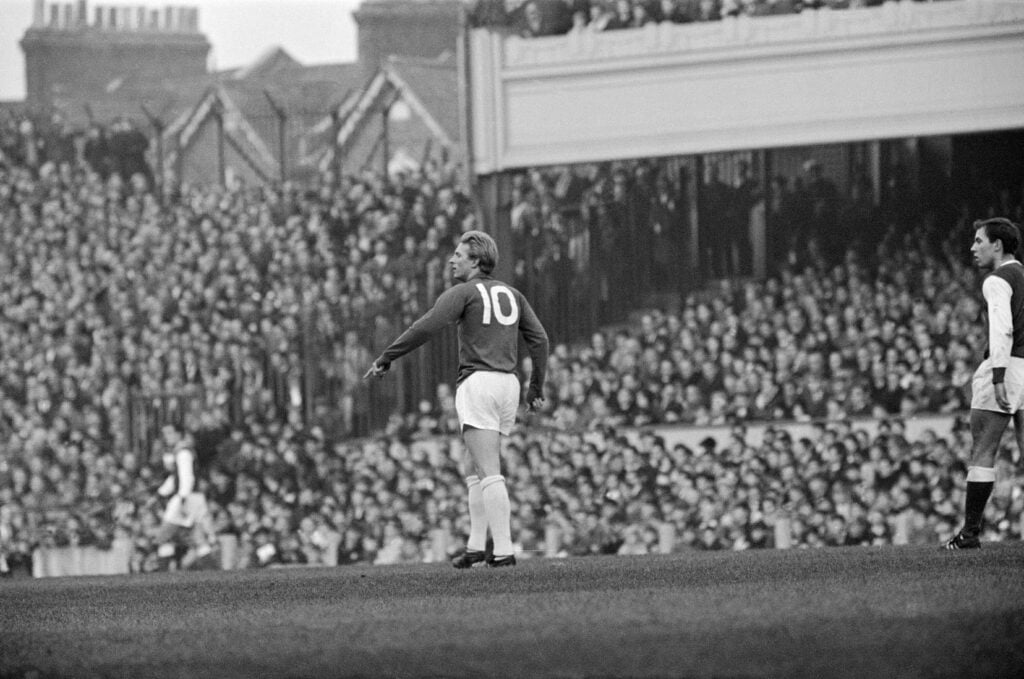
Sir Matt Busby decided to strengthen the team again before the season by signing another striker, bringing in Denis Law from Torino, Viollet’s replacement.
Law’s 29 goals helped United stave off relegation, finishing just three points clear of 21st place City, who went down. United began by winning only three of the first 14 matches of the campaign, and registered only 12 victories in total.
The 19th placed finish was another new low of the Busby era, but the 1962/63 season ended on a remarkable high.
United signed Paddy Crerand from Celtic in February, strengthening the team’s midfield. He would go on to make more than 300 appearances for the club.
United won the 1963 FA Cup Final with a 3-1 victory over Leicester City in front of 100,000 fans at Wembley. This made up for the two previous defeats in the Final, and it was United’s first piece of silverware post-Munich.
David Herd (2) and Denis Law scored the goals in the Final. Law had managed five goals to help United reach the Final, while Quixall scored in four out of the five rounds. This was a victory that inspired hope.
1963/64
- Final Position: 2nd
- FA Cup: Semi-finals – Eliminated by Liverpool
- League Cup: Did not enter
- European Cup Winners Cup: Quarter-finals – Eliminated by Sporting
- Top Scorer: Denis Law (46)
The 1963/64 season saw a dramatic turnaround as Manchester United went from finishing 19th in the league to 2nd place. The team finished only four points behind Liverpool. Busby had turned United back into title-challengers again.
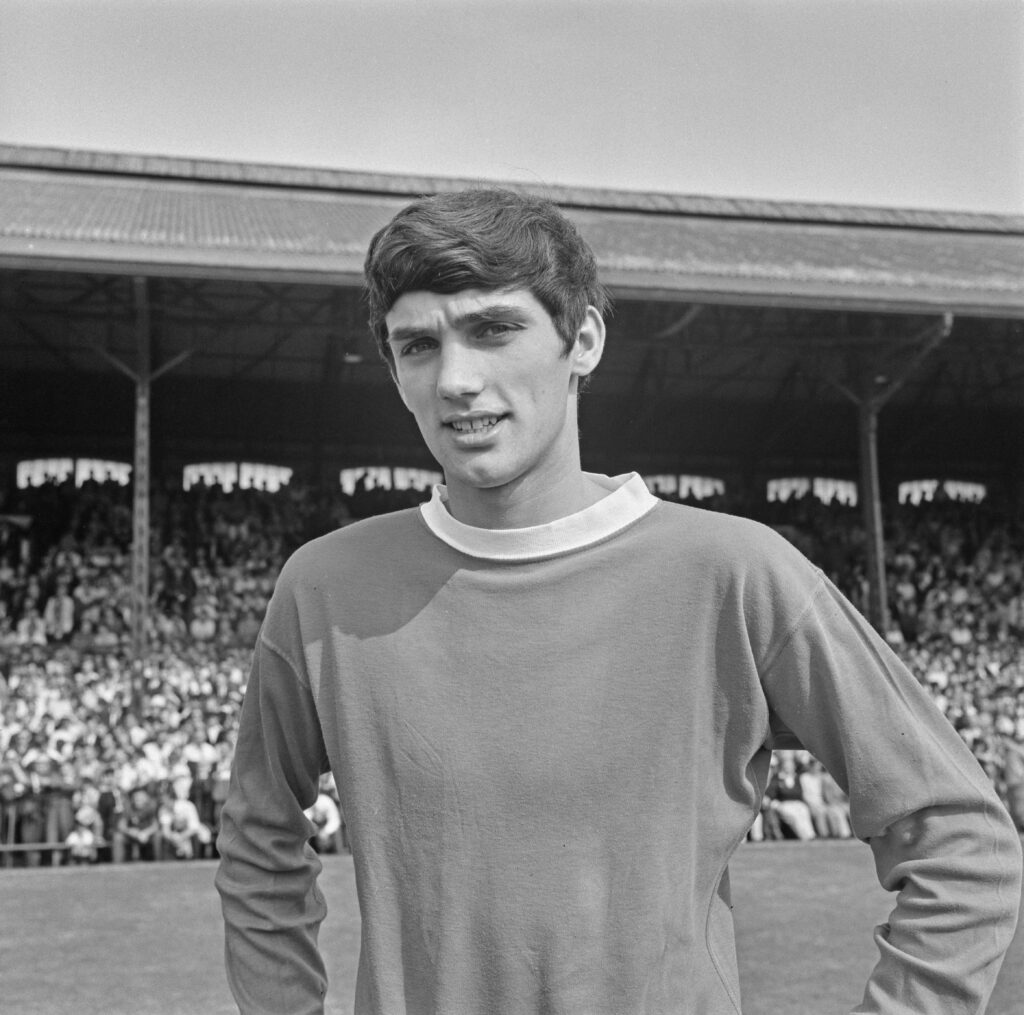
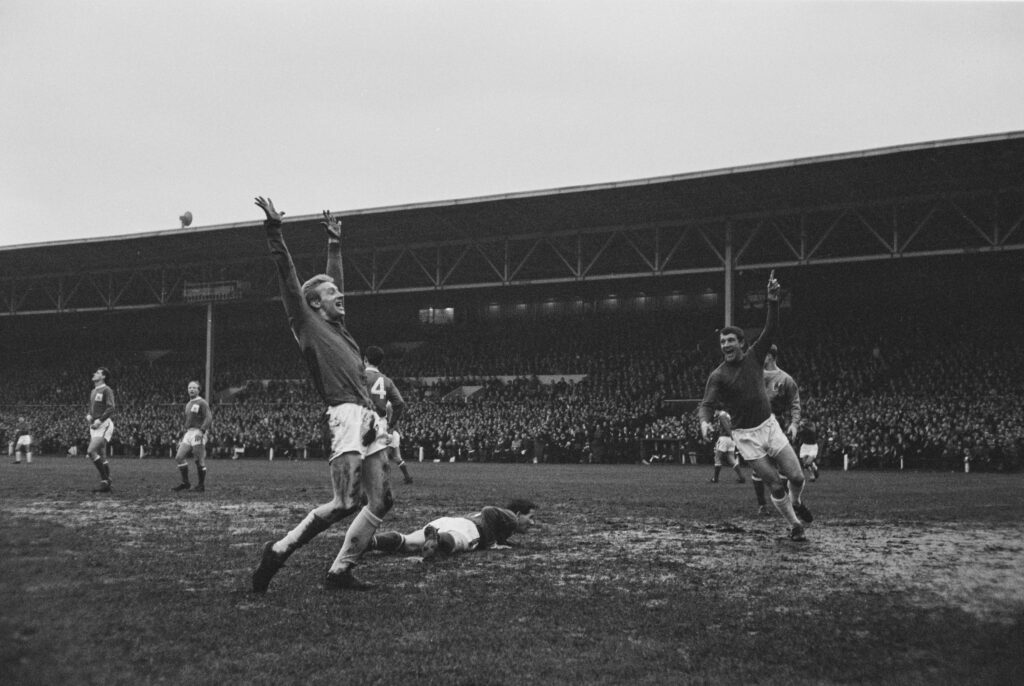
The campaign featured the debut of George Best, and the famous Trinity of Best, Law and Charlton played together for the first time. In addition to scoring six goals in 26 first team appearances, Best also captained United’s youngsters to winning the 1964 FA Youth Cup.
Denis Law put together the best total scoring season ever seen in a Manchester United shirt, with 46 in all competitions in only 42 appearances. 30 of these goals came in the league – shy of Viollet’s record of 32.
David Herd also scored a notable 27 goals in all competitions.
League highlights included a Law hat-trick in a 7-2 win over Ipswich, and he scored four in a 5-1 victory against Stoke City.
United’s defence of the FA Cup ended with a 3-1 semi-final defeat to West Ham. Law had struck two hat-tricks to help United get there.
The club also entered the European Cup Winners’ Cup competition for the first time, beating Willem II and Tottenham to reach the quarter-finals.
Law scored a hat-trick in a 4-1 home win over Sporting – but United totally collapsed in the second leg, losing 5-0 in Lisbon.
⭐ Were you lucky enough to see George Best play?
Tell us about your memories…

1964/65
- Final Position: Champions
- FA Cup: Semi-finals – Eliminated by Leeds
- League Cup: Did not enter
- Inter-City Fairs Cup: Semi-finals – Eliminated by Ferencvaros
- Top Scorer: Denis Law (39)
Champions again! Matt Busby achieved the impossible, leading Manchester United back to title glory just seven years after the Munich disaster.
Manchester United won the title on Goal Average ahead of Leeds, with both teams tied on 61 points.
Goal Average was a system that divided goals scored by goals conceded. Busby’s United had scored more goals and conceded fewer than Leeds. This meant United’s Goal Average was 2.2 compared to Leeds’ 1.5 GA.
The defensive turnaround was key, with United conceding only 39 goals in 42 games. This was the fewest goals United had ever allowed in a 42 game season, and less than half the 80 league goals conceded in 1959/60.
George Best struck 14 goals for United over the course of the campaign, a figure bettered by four players, Bobby Charlton (18), John Connelly (20), David Herd (28) and Denis Law (39). Four of Law’s goals came in a thumping 7-0 league win over Aston Villa.
Leeds did get some recompense against Manchester United in the FA Cup, winning a semi-final replay 1-0, after a goalless first game.
United were back in Europe too, competing in the Inter-City Fairs Cup, a predecessor to the UEFA Cup, now the Europa League. Busby’s side knocked out Djurgarden, Borussia Dortmund, Everton and Strasbourg to reach the semi-finals.
This set up an epic tie with Hungarian side Ferencvaros over two legs, which turned into three.
United won the first leg 3-2 with two goals from Herd and one from Law. Ferencvaros won the second leg 1-0, tying the game on aggregate.
With no penalty shootouts, this set up a third match between the two teams as a play-off decided. Ferencvaros got to host the game after winning a coin toss. By this point it was mid-June, with the league season completed in April.
United lost the game 2-1, but picked up valuable European experience along the way. Ferencvaros won the final 1-0 against Juventus, and this remains the only European trophy ever won by a Hungarian club.
1965/66
- Final Position: 4th
- FA Cup: Semi-finals – Eliminated by Everton
- League Cup: Did not enter
- European Cup: Semi-finals – Eliminated by Partizan Belgrade
- Top Scorer: David Herd (33)
United fell short in all areas in 1965/66, attempting to compete on multiple fronts. In the league the team finished in fourth place, failing to retain the league title.
This was despite United outscoring the three teams above them. This season the defensive solidity of a year ago had disappeared, conceding 59 goals compared to 39.
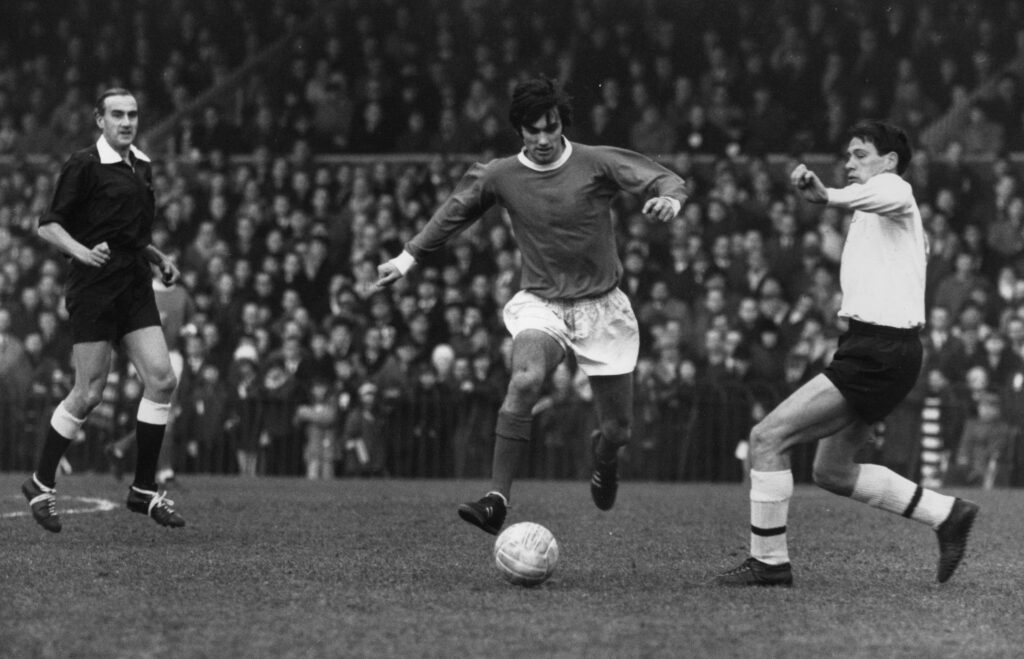
Denis Law scored 25 goals, outdone this season by David Herd who had 33. Bobby Charlton struck 18 of his own, while George Best enjoyed his best campaign to date with 17 goals.
United were eliminated in the semi-finals of both the FA Cup and European Cup, and the adventure in the latter was quire eventful.
The team began with a 9-2 thumping over two legs to beat HJK Helsinki in a preliminary round, with John Connelly scoring a hat-trick in a 6-0 second leg win.
United eventually reached the quarter-finals against Benfica, winning the first leg 3-2 with goals from Foulkes, Herd and Law. This set up a tricky second leg in Portugal, with United still remembering the collapse against Sporting in the Cup Winners Cup.
A spectacular performance from George Best ensured there was no repeat, with United winning 5-1 away at Benfica, with the Northern Irishman scoring twice. This performance saw him dubbed ‘El Beatle’ by the foreign press.
A 2-0 first leg away defeat to Partizan Belgrade was too much to overcome in the semi-final, with David Herd’s goal giving United a 1-0 defeat in the second leg. To reach this stage of the competition so soon after 1958 was in itself a special accomplishment.
1966/67
- Final Position: Champions
- FA Cup: Fourth round – Eliminated by Norwich City
- League Cup: Second round – Eliminated by Blackpool
- Top Scorer: Denis Law (25)
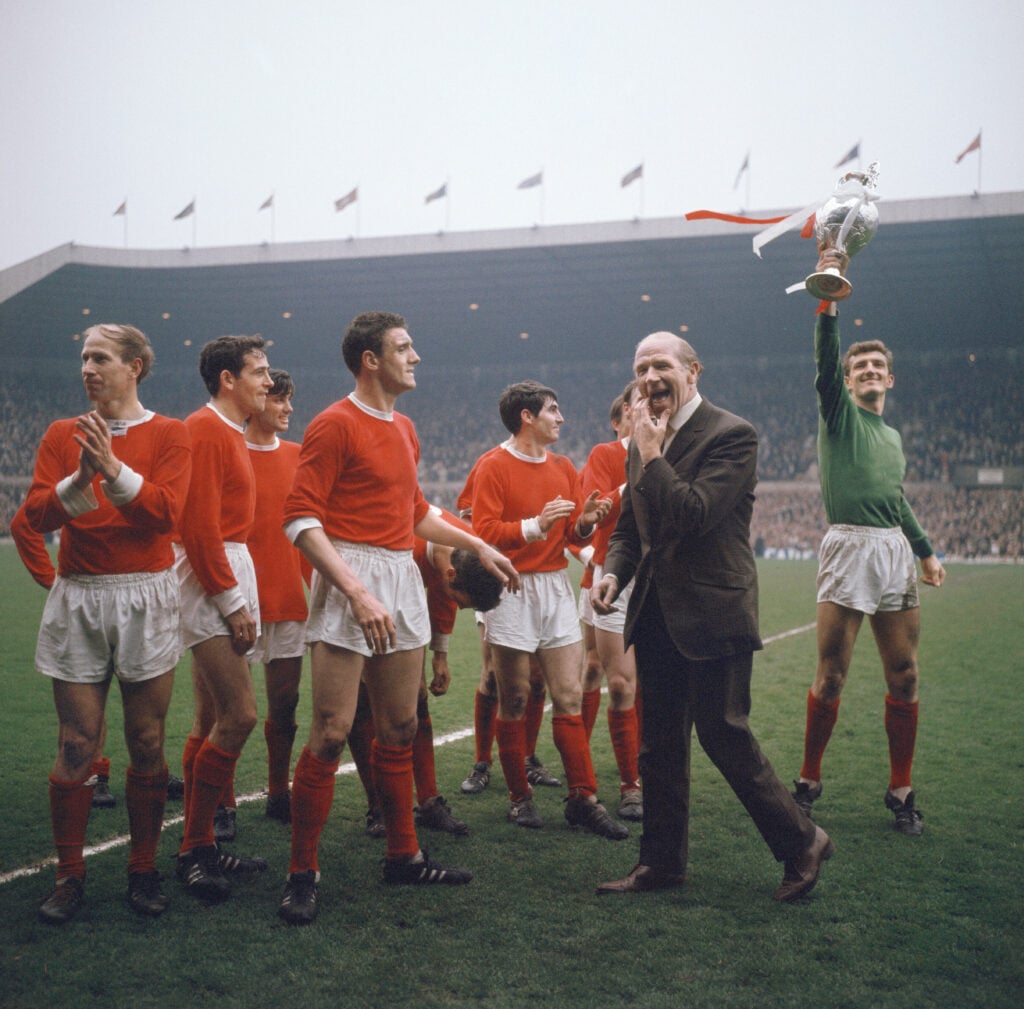
Manchester United won the title again, for a fifth and final time under Matt Busby, beginning a drought ended only by Alex Ferguson in 1992/93.
The 1966/67 title win came with a four-point margin, and was led by a 20-game unbeaten run from December 27 to the end of the season.
The Red Devils clinched the title with a game to spare, beating West Ham 6-1 at Upton Park, in front of a record 38,000 attendance at the stadium. A young Harry Redknapp was among the West Ham team.
The Guardian reported: “The day belonged to Charlton, the player most endeared to the world of football. No one had the key to lock up his genius in midfield-few defences have.
“That delightful control of the ball, the crisp pass, the swift change of direction which takes him round a defence-he passes six West Ham defenders in one such manoeuvre-and the devastating shots were all there to savour.”
With no European football after finishing trophyless the previous year, United were able to concentrate focus on the league campaign. Denis Law (25), David Herd (18), Bobby Charlton (12) and George Best (10) all scored into double figures.
Bobby Charlton and Nobby Stiles entered the season as newly crowned World Cup winners with England, and both played 40 games or more over the course of the 1966/67 campaign.
1967/68
- Final Position: 2nd
- FA Cup: Third round – Eliminated by Tottenham
- League Cup: Did not enter
- European Cup: Champions
- Top Scorer: George Best (32)
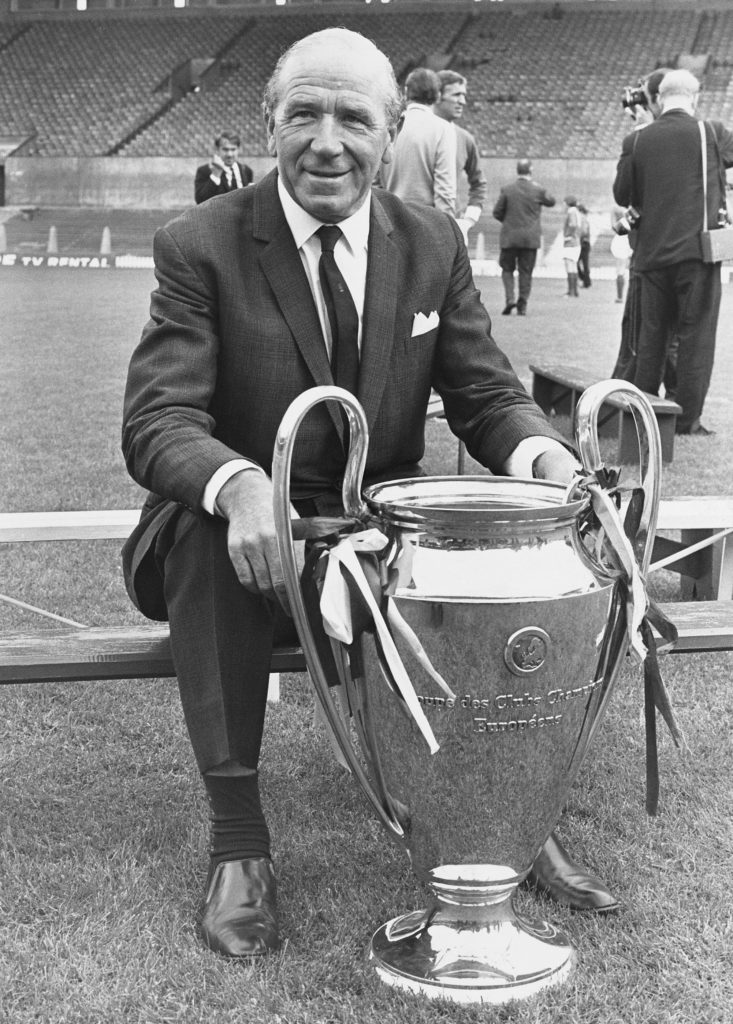
Matt Busby’s crowning moment saw Manchester United win the European Cup, becoming the first English team to ever win the competition. It was a moment of destiny, 10 years after the tragedy of 1958.
To reach the Final, United had to overcome a tough quarter-final tie against Polish club Gornik Zabrze, winning 2-1 on aggregate, before a semi-final with Real Madrid.
A goal from George Best game United a 1-0 advantage from the home leg, before 125,000 spectators packed the Bernabeu to watch an epic 3-3 draw in the second leg. Bill Foulkes, David Sadler and an own goal saw United through.
This set up a dream European Cup Final at Wembley for United, attended by 100,000 fans. Wearing a changed blue kit, Bobby Charlton’s second half goal was equalised by Jaime Graca, forcing extra-time.
George Best haunted Benfica again with a solo goal to give United the lead, and they never looked back. Charlton scored another and young forward Brian Kidd rounded off a dream result to lead a 4-1 victory.
John Aston was United’s man of the match, while Alex Stepney drew praise for thwarting Portuguese forward Eusebio. It was even more impressive to accomplish the feat without the injured Denis Law, who was nursing a knee injury from hospital.
Stepney himself later praised George Best’s contribution. He told MUTV in 2024: “He was incredible. I don’t think any other player in the world would have done what he did in that particular moment when he scored against Benfica in extra-time.
“When he nutmegged the defender and went around the goalkeeper. I don’t think any other player would have done that. Not like George did.”
Domestically, United missed out on winning the title by two points to rivals City. Although because they had a superior Goal Average, United required an additional three.
George Best scored a stunning 32 goals in all competitions, and was subsequently awarded the Ballon d’Or.
1968/69
- Final Position: 11th
- FA Cup: Quarter-finals – Eliminated by Everton
- League Cup: Did not enter
- European Cup: Semi-finals – Eliminated by AC Milan
- Intercontinental Cup: Defeated by Estudiantes
- Top Scorer: George Best (22)
The 1968/69 was a big comedown for Manchester United after the highs of European Cup success in 1968.
In January 1969, Busby announced his intention to retire at the end of the season. United won only one of the next six games, before demolishing QPR with a 8-1 victory.
The team picked up form but finished in a middling 11th place, which was still two places above defending champions City.
United’s defence of the European Cup came to an end with a semi-final defeat to eventual winners AC Milan, losing 2-1 over two legs, with Charlton scoring the goal.
The Red Devils also played in the Intercontinental Cup against Estudiantes, a side featuring the father of future United midfielder Juan Sebastian Veron. United lost 2-1 on aggregate.
1969/70
- Final Position: 8th
- FA Cup: Semi-finals – Eliminated by Leeds
- League Cup: Semi-finals – Eliminated by City
- Top Scorer: George Best (23)
Manchester United’s new manager was Wilf McGuinness, and there were incremental improvements on the previous season. The team finished in eighth place instead of 11th, scoring more goals and picking up three more points. A 7-0 league victory over West Brom was a highlight.
Another notable result was a 4-1 away win at Liverpool, which remains the club’s biggest ever away victory at Anfield, a McGuinness record that still stands.
The real highlight came in the FA Cup, with George Best scoring a stunning six goals in a 8-2 victory over Northampton.
United were eventually knocked out in the semi-final against Leeds, but it took three attempts. The first game finished 0-0, forcing a replay. The replay also finished 0-0 after extra-time.
This forced a second replay, with Leeds winning 1-0. United did beat Watford 2-0 in a third place playoff.
United competed in the League Cup again, reaching the semi-final, losing 4-3 on aggregate to City.
Denis Law was only able to play 10 games due to injury, with Brian Kidd stepping up with 20 goals, supporting Best’s 23.
1970/71
- Final Position: 8th
- FA Cup: Fourth round – Eliminated by Middlesbrough
- League Cup: Semi-finals – Eliminated by Aston Villa
- Top Scorer: George Best (21)
The 1970/71 season featured a surprise return for Matt Busby, who stepped back into the dugout after McGuinness was fired in late December. United had won only five of 23 league games, and were situated in 18th place.
Busby had an immediate impact, winning four and drawing one of his opening five games in charge. He led United to finish in 8th place in the table, signing off with a 4-3 victory over rivals City, with George Best scoring the final goal.
This was the real end of the Busby era, with Frank O’Farrell taking over the following season.

Trophies
The Sir Matt Busby era was a glorious one, with Manchester United winning five league titles, two FA Cups and one European Cup. It was a staggering collection of trophies, bettered only later by Sir Alex Ferguson in the 1990s and 2000s.
Busby lived long enough to see Ferguson end the title drought in 1992/93, before his death in January 1994.
Receive a digest of our best United content each week direct to your mailbox