

Manchester United won two Champions Leagues under Sir Alex Ferguson, and reached two more Finals. There were several near misses, and one in particular stings hard.
When Sir Alex Ferguson’s Manchester United sides were defeated by Barcelona in 2009 and 2011, there were few complaints. United were beaten in both games by two clear goals, and had the simple misfortune to come up against one of the greatest sides ever to exist.
Ferguson was furious when Nani’s red card influenced the game in 2013 against Real Madrid in a decisive knockout tie. It was his final chance to win another Champions League.
His best chance to win an extra trophy had already passed him by. It came in 2004, when United were defeated by Porto at Old Trafford, in a result that changed the landscape of football forever.
Was this the worst XI Sir Alex Ferguson ever selected for a European knockout tie?
What are your memories of the defeat to Porto in 2004?

United had to win, despite Roy Keane absence
I was at Old Trafford in 2004 to watch Manchester United take on Porto in the Champions League last 16, and the crushing disappointment of the result will live with me forever. It was not just the result, it was the feeling that we had been totally robbed.
United had gone into the game 2-1 down from the first leg after a Benni McCarthy brace at the Dragao. We had actually taken the lead through an early Quinton Fortune goal.
So while we entered the return leg with a deficit, I was not unduly concerned as memories were still fresh from one of the greatest ever Champions League performances at Old Trafford, when United beat a far more dangerous Porto side 4-0 in 1997.
The year prior in 2003, it had taken a hat-trick from Ronaldo – the original – to knock us out of Europe in an epic tie with Real Madrid. I felt confident that we surely had too much quality to be bothered by Porto over two legs.
Ruud van Nistelrooy was a powerhouse in Europe, and after he failed to score in the first leg, surely we were in for a goal glut under the Old Trafford lights.
If there was one reason to be doubtful, it was Roy Keane being suspended after his record card in Portugal.

Paul Scholes’ disallowed goal should have counted
Manchester United’s starting line-up was unbalanced to say the least. Gary Neville was starting in central defence, one of the repercussions of Rio Ferdinand’s ban for a missed drugs test.
Darren Fletcher was selected on the right wing ahead of Cristiano Ronaldo, while the midfield pairing of Nicky Butt and Eric Djemba-Djemba was sketchy to say the least.
Why was I so confident again?
Any pre-match nerves were displaced when a marauding John O’Shea helped make the breakthrough with a run and cross for Paul Scholes to score. The Irishman was on quite a rise, famously nutmegging Figo against Madrid in his previous Champions League home knockout game.
Scholes was playing in a forward role supporting Van Nistelrooy, and caused problems for a Porto defence that we would later learn deserved a lot more credit than I gave them pre-match.
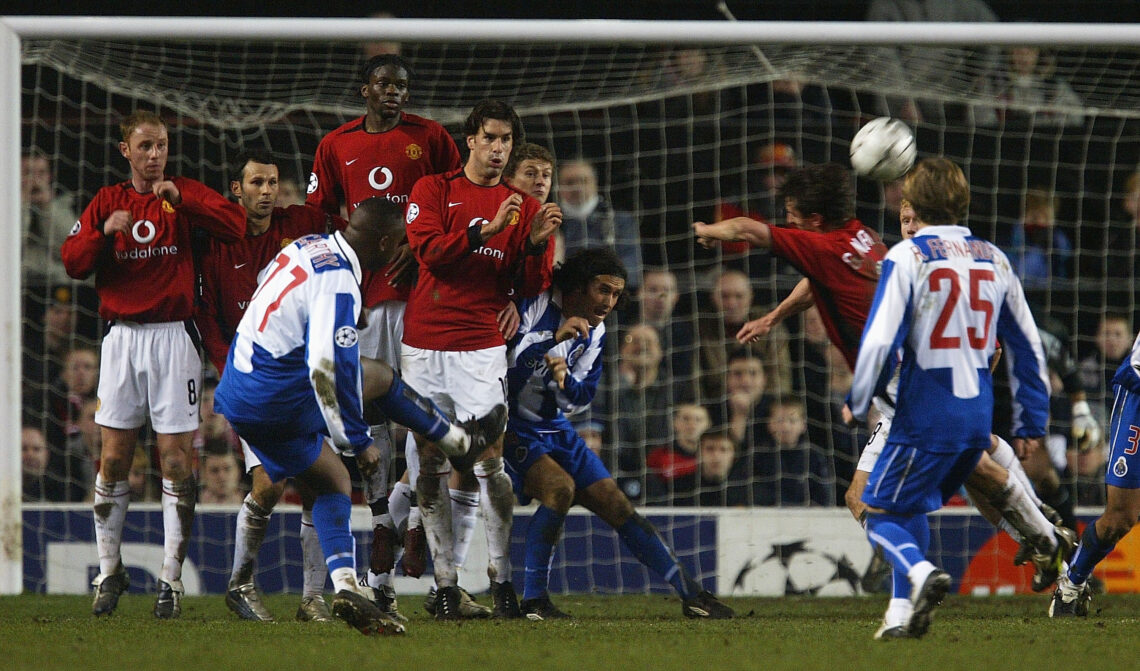
Just before half-time, Scholes had the ball in the net again (pictured above), and it was a moment that haunts me to this day, so I can only imagine how Sir Alex feels.
Sat up in the heavens in the North Stand as it was then known, I was perfectly in line with Scholes as he scored past Vitor Baia. It was ruled offside with a late call from the linesman.
The decision was a scandal. This was not one of those hairline offsides that you see given via VAR these days. This was blatant.
If I could see it was onside from my seat, how couldn’t the linesman?
With VAR in those days, or a competent official, United go in at the break 2-0 up and for me, it would have been ‘game over’, halfway there to another 4-0 win over Porto.
Instead the call kept Porto in the game at the break, and everything changed.

Costinha’s equaliser and Jose Mourinho’s run
United had two goals in the net in the first half, and while only one was given, there was plenty of reason to believe we would score again in the second 45 minutes.
I’m still at a loss to explain really how United blew it in the second half. My two conclusions are (a) the flaws in this team really began to show, and (b) Porto were actually quite good.
As the second half kicked off, United were 1-0 up on the night and it was 2-2 on aggregate. Crucially, we were still going through on away goals.
Scholes was moved back into a more withdrawn role in the second half, with Djemba-Djemba subbed at half-time for Louis Saha. This was Fergie ‘going for it’, looking to kill the game off. But the service to the two forwards was never right.
Van Nistelrooy was surprisingly well shackled by Porto’s defence, led by rising star Ricardo Carvalho.
Cristiano Ronaldo came off the bench, but his night was a disaster. He ended up being stretchered off after eight minutes, a sign that things were not going United’s way.
The atmosphere at Old Trafford became more and more nervous as the game went on. Nothing was going right, and it looked like we would have to settle for a 1-0 win and an away goals victory.
That was until a disastrous moment in stoppage time when Phil Neville conceded a late foul, as he was prone to doing in big moments.
Benni McCarthy’s free-kick was on target and Tim Howard made a complete mess of it, parrying the ball to Costinha, who scored an equaliser on the night, and a goal that gave Porto a 3-2 lead.
Immediately I could see two things. Some fans had walked out already, despite United’s record of late comebacks. One in the row in front even left before the free-kick was taken. He clearly figured that if there was a goal, he didn’t want to see it, and if it was inconsequential, he wouldn’t miss anything.
What he missed was the second thing that caught my eye. Porto’s manager running down the Old Trafford touchline to celebrate.
I barely knew his name at that point. He had caught my eye in the pre-match press conference, but I thought little of it.
But what I ended up seeing was the moment that propelled Jose Mourinho‘s career, as he landed a significant knockout blow to Manchester United, enhancing his own reputation along the way.
I didn’t take too much notice at the time. I was too concerned with checking the clock, how many minutes left for a United goal?
A couple of minutes remained and United pushed forward. But it led to nothing. Porto ‘Parked the Bus’ and this was one of those nights where we could have played 45 minutes of stoppage time and wouldn’t have scored. We had lost our attacking edge completely, and were left ruing the ‘offside goal that wasn’t’ from the end of the first half.
And that was it. Another season of European disappointment.
Unlike the brave loss and inspiring performance to Real in 2003, the exit to Porto was a miserable one with no positives to cling onto.
Sir Alex Ferguson won TWO Champions League titles in 1999 and 2008, but had several near-misses…
… which Champions League run under Fergie was the ONE THAT GOT AWAY for you?

United’s missed opportunity for a wide open path
The frustration from Manchester United’s defeat sharpened when the draw for the Champions League quarter-finals was made.
Porto were drawn against a talented Lyon side in the quarter-finals.
They then faced Deportivo La Coruna in the semi-finals, a side United knocked out of the competition in 2002.
And then the Final? Porto cruised past Monaco with a 3-0 win in a one-sided game between two surprise finalists.
Porto deserved their trophy that year. But they also took advantage of the weakest Champions League in memory. Monaco had knocked out Madrid and Chelsea on the other side of the draw, while Italian and German sides were nowhere to be seen.
This was the year Manchester United just needed to be a 7/10 or an 8/10 and we very likely would have gone on to win the Champions League.
Instead we could only deliver a weak 5/10 team by our standards, and the performance at Old Trafford was even worse.
Mourinho ended up at Chelsea. He had a linesman to thank.
Without this – would he ever have become Manchester United manager in 2016?
It’s amazing to think how this one awful offside call changed the course of football history.
The reality about the 2004 side
I probably knew it at the time deep down. This Manchester United team was not up to much, and the bans being served by Keane (one-match) and Ferdinand (eight months) impacted the team more than they should have.
We should have had enough to win regardless. But it is easy to see why we fell apart.
Mikael Silvestre was injured and missed the game, forcing a reshuffle of the defence, and perhaps as much as I like to think about the opportunity – a Wes Brown and Gary Neville centre-back pairing probably wasn’t good enough for Champions League glory.
The Eric Djemba-Djemba and Nicky Butt axis in the middle certainly wasn’t.
Ronaldo was in his first season and not trusted yet to start a big game. And there was a reason David Bellion, Diego Forlan and Kleberson were unused substitutes.
United did go on to win the 2004 FA Cup, so it was not a completely lost season.
And this should not be denigrated because it was ‘just’ a win against Millwall in the Final.
United won the ‘real final’ in the semis by beating the so-called invincible Arsenal team 1-0 at Villa Park thanks to a Paul Scholes goal. One that counted.
This was evidence enough that United were good enough to win trophies despite the deficiencies.
All we needed against Porto was for the ‘offside goal’ to have been ruled onside. Champions League glory may have beckoned.

What Sir Alex Ferguson did next to secure his legacy
Sir Alex Ferguson was known for being ruthless, and Manchester United’s Champions League exit to Porto sparked a series of decisions over a two-year period that led the club back on the route to success.
Tim Howard was one of those who bore the brunt. This was the beginning of the end for him.
While Howard started the FA Cup Final against Millwall, Roy Carroll was selected ahead of him for the decisive game against Arsenal.
He started only 12 league games the following season, reverting to a back-up role before being eventually loaned and sold.
By 2005 United had signed Edwin van der Sar, finally fixing the goalkeeper position after a long six-year search to find Peter Schmeichel’s successor.
Nicky Butt received the harshest treatment. The once reliable midfielder was deemed reliable no-more and he was sold to Newcastle in summer 2004 for just £2.5 million. Phil Neville was sold 12 months later.
Ferguson bought Wayne Rooney the same summer, signing a player capable of becoming a future legend, who delivered instantly.
Roy Keane’s infamous exit followed in 2005 with Van Nistelrooy sold in 2006.
Ferguson already had his attacking replacement, while Michael Carrick arrived to fill Keane’s role, and shirt number.
Out went Howard, Keane and Van Nistelrooy, in came Van der Sar, Carrick and Rooney. Add in a returning Rio Ferdinand, and within two years Manchester United had a completely new spine to the team that started against Porto.
It changed Ferguson’s legacy forever.
He was not destined to drag a bad Manchester United team to European glory in 2004.
He was inspired to create one of the greatest iterations of his team we had ever seen, the 2008 Champions League winners, who also won three Premier League titles in a row.
Receive a digest of our best United content each week direct to your mailbox