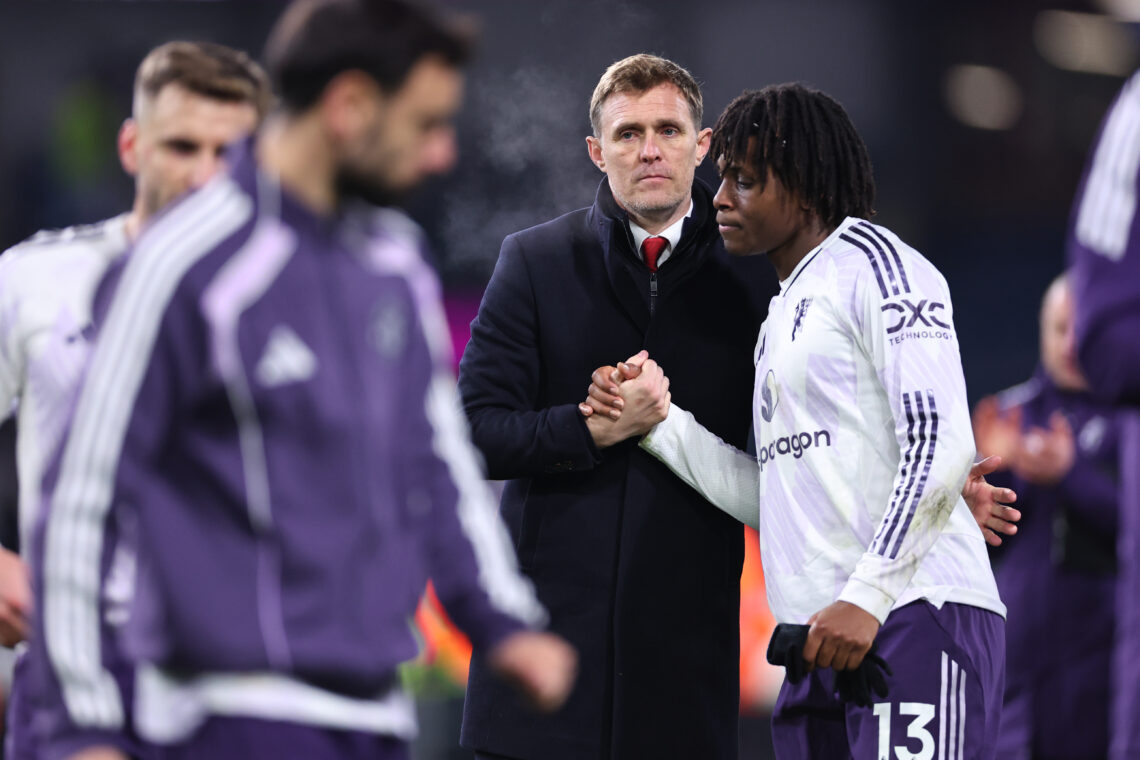


Paul Scholes hasn’t liked much about Manchester United since Ruben Amorim’s appointment, but as soon as he was sacked, United did something Scholes has been asking for all along.
The spectre of ex-players-turned-pundits annoyed Ruben Amorim to no end, with the Portuguese often believing they were dictating the operations within the club with their strong opinions.
As a result, it trapped him in a vicious cycle, since he pushed back at them, leading to the likes of Paul Scholes and others being even harsher in their takes.
Should club legends protect the badge or tell the truth?🤔
Are former Manchester United players TOO HARSH on the club in the media, or are you happy for them to tell it like it is?
Does it matter? Are current United players TOO SOFT?

Scholes will be delighted, therefore, to finally see United doing what he’s been asking them to do against Burnley.

Man Utd fulfilled Paul Scholes’ demand vs Burnley
In many ways, Ineos fulfilled Scholes’ demand even before the ball was kicked against Burnley, because he’s been asking for “United DNA” to return to the club.
Not many get that DNA more than Darren Fletcher, who came through the academy and has worked under multiple managers at the club.
The reason why Scholes insisted on it often was because he didn’t think Amorim was playing the “United way”, which is to do with fast and direct wingers, vertical play, and the striker being a fox-in-the-box.
He thought only a manager schooled in this way could execute it, and Fletcher proved that to be the case with what United did in the second half vs Burnley.
Eyebrows were raised when Fletcher deployed Patrick Dorgu as a left winger instead of a full-back or on the right, but it paid off for United’s second goal.
In a passage of play straight out of Sir Alex Ferguson’s playbook, Dorgu stretched the play by remaining high and wide, took on his full-back to go on the outside, and whipped in a devilish cross.
Benjamin Sesko stole a march on his defender and cleverly guided it past the goalkeeper to score the simplest of goals.
Should Patrick Dorgu continue at left wing after that performance?
A new position for Patrick Dorgu under new management?

In an era of inverted wingers and deep-lying link-up strikers, this was a throwback to what Sir Alex’s teams were built on in the 90s, and Scholes would have been delighted to see Fletcher bring it back.
United need to mix tradition with modernisation
It’s good that Fletcher brought United back to its roots against Burnley, with the second goal perfectly encapsulating “United DNA,” but they can’t be one-trick ponies.
Football has evolved, and it’s why Scholes often gets ridiculed for continuously romanticising the past.
Goals like that need to be a part of a well-rounded attacking unit that can do slick interplays and false 9s as well as they do traditional crossing and penalty box poaching.
There’s a middle ground to be had between Ruben Amorim’s extremely methodical positional play and a system based on off-the-cuff moments of inspiration.
The marriage of two leads to a successful team, but getting the tradition back is a nice starting point because United were starting to lose both under Amorim.
Receive a digest of our best United content each week direct to your mailbox