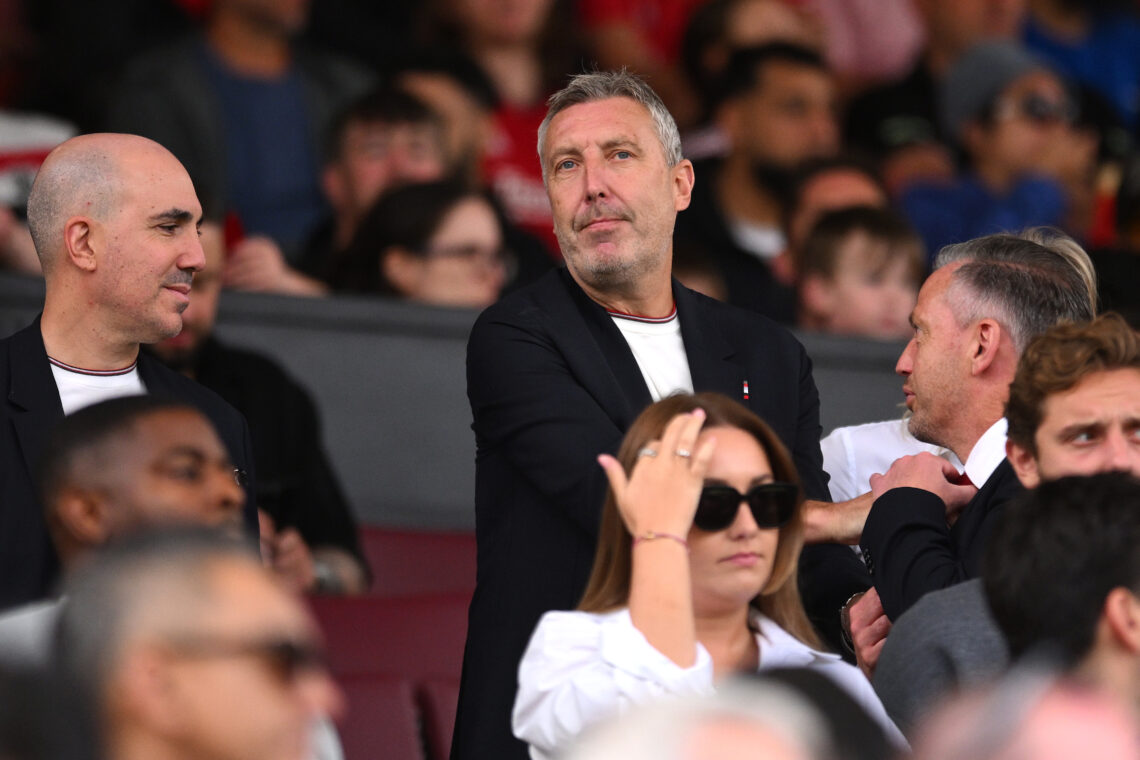

Jason Wilcox appeared on the first episode of a new podcast series produced by Manchester United called ‘Inside Carrington’.
Manchester United director of football Jason Wilcox appeared on the first episode of a new podcast series produced by the club called Inside Carrington.
The mood has lifted at United in recent weeks following an unbeaten run of four Premier League matches, winning three of those, including a 2-1 victory over Liverpool at Anfield.
Ruben Amorim has been able to ease some of the pressure on his shoulders, with Sir Jim Ratcliffe giving his full backing, despite a slow start to the 2025/26 campaign.
In a new podcast, Wilcox provided insight into his role as director of football as well as United’s plans for the future.
Without further ado, here are five things we learned from Wilcox’s interview.

How Man Utd conduct transfers
Perhaps one of the most insightful segments from the podcast came as Wilcox provided a fascinating insight into United’s transfer processes.
Wilcox reflected on his last 18 months at Old Trafford when asked to describe how the club’s recruitment works. He explained that the first summer transfer window was more chaotic than the second because they had more time to plan for the previous window.
“Last year’s summer window [2024] was a lot more chaotic than this one and this one was really calm. With this one, we knew the plan, we knew which players we were going to target, we had our lists, we knew which areas of the pitch we needed to improve.
“These are continuous meetings with myself and Ruben [Amorim], with Chris Vivell and with his team underneath, where we are very clear on the profiles that we need. So, the brief will come from myself and Ruben, it goes into Chris, there is a lot of debate and discussion around the profiles that we need, and then the scouts will go into the market, we will combine that with the data team and then there will just be constant dialogue.
“Right now, I am having weekly meetings with the recruitment team on the different profiles, the age bracket, the cost, are they attainable, with Ruben as well, so it is a really joined-up approach. When we sign a player, there are so many people that are involved in the process. The data team are involved in the process and we will then focus all our attention on certain players.
“It is really important then that we do the background checks on whether they are clean-living professionals. This is really important. This year, we looked at Premier League-ready players and certainly with Bryan [Mbeumo] and Matheus [Cunha], we couldn’t take too much risk in this area. We needed players that we could plug in and play, with little transition time.”
Bryan Mbeumo and Matheus Cunha benefiting from Benjamin Sesko
Wilcox has been impressed by Benjamin Sesko and suggested that he thinks the striker has been unfairly criticised due to the extra scrutiny that United attract.
The 22-year-old was praised for making runs that create space for Bryan Mbeumo and Matheus Cunha.
Wilcox also stressed that Sesko is going to become an ‘amazing player’. He also praised last year’s signings Ineos made prior to the summer for being good professionals.
“Benji, at the top end, he’s going to be an amazing player. It’s difficult to be the no.9 at United and I know sometimes that Matheus and Bryan are getting a lot of credit, but the runs that Benji is making is also helping Matheus and Bryan as well.
“All four of them have done really well, the summer signings from last year, they are top professionals.”
Man Utd not trying to replicate the Harlem Globetrotters
Wilcox insisted that United’s approach in the transfer market is about finding the right players for the team, and not recruiting big-name stars without any background checks.
Eric Cantona was used as an example of the type of professional they want to bring to United.
“You have to bring players in that bring something different to the changing room, but the most important thing is that whenever we’re bringing in a player who comes here, they have to want to improve and they have to be a team player, and understand what it means to be part of a successful team.
“It’s not about putting the Harlem Globetrotters (an American exhibition basketball team) together. If I look at the successful Man United teams, there was very functional players that would die for the badge and there were some mavericks.
“When you talk about [Eric] Cantona, when you hear anybody talk about him, he was an ultimate professional. When I look now and I see the car park, the report time is at 9.45am, you see the lads coming in at 8.30am, 8.45am, preparing for training. This is a good sign.”
Work never stops for Jason Wilcox
Wilcox explains that he receives constant phone calls and text messages from football agents since becoming United’s director of football. It is a challenge he faces at home – after work hours – but he is always trying to help the team improve with a long-term view for the future.
“The phone, I think anybody in this role is getting a lot of phone calls, a lot of messages from agents that are pushing players and it’s part of the job. I think, when I go home, there are times when I forget to leave my phone downstairs and it’s at the side of the bed pinging and all that, and that is not good practice and you’ve got to try to get away from it.
“The transfer windows, I know we have certain blocks where it’s in the summer and in the winter, but really we are working on recruitment year-round.
“We are thinking about it constantly, thinking about the squad, thinking about which players’ contracts will be starting to come to an end and the planning is really important. It’s really important that we are on top of things.
“In the summer, for all the players that we signed, there were big clubs wanting to sign them and they shut out all the other clubs because they wanted to come to Man United.”
Ruben Amorim ‘more flexible’ than people think
Amorim recently celebrated his first anniversary as United head coach.
The Portuguese coach has been heavily scrutinised in that time for persisting with his preferred 3-4-2-1 system.
However, Wilcox believes Amorim is ‘more flexible’ than people think and has called on the team to continue building the spirit in the dressing room.
“We’ve just got to continue to build the spirit, continue to build on Ruben’s idea. Ruben has got a very clear idea. It’s a lot more flexible, the idea, than what people give it credit for. We have got to start with the end in mind and understand the game model, how Manchester United are, it is really important and we have to put the jigsaw pieces together.
“Putting the jigsaw pieces together, we would love to have all of the pieces in place where we can see a very, very clear picture but, whilst we are building and whilst we are building the picture, it is even more difficult when you lose some football matches because people start questioning things. But we are really clear, myself and Ruben, Omar [Berrada], the ownership, we are really clear on the direction of travel and this is really important.”
Receive a digest of our best United content each week direct to your mailbox