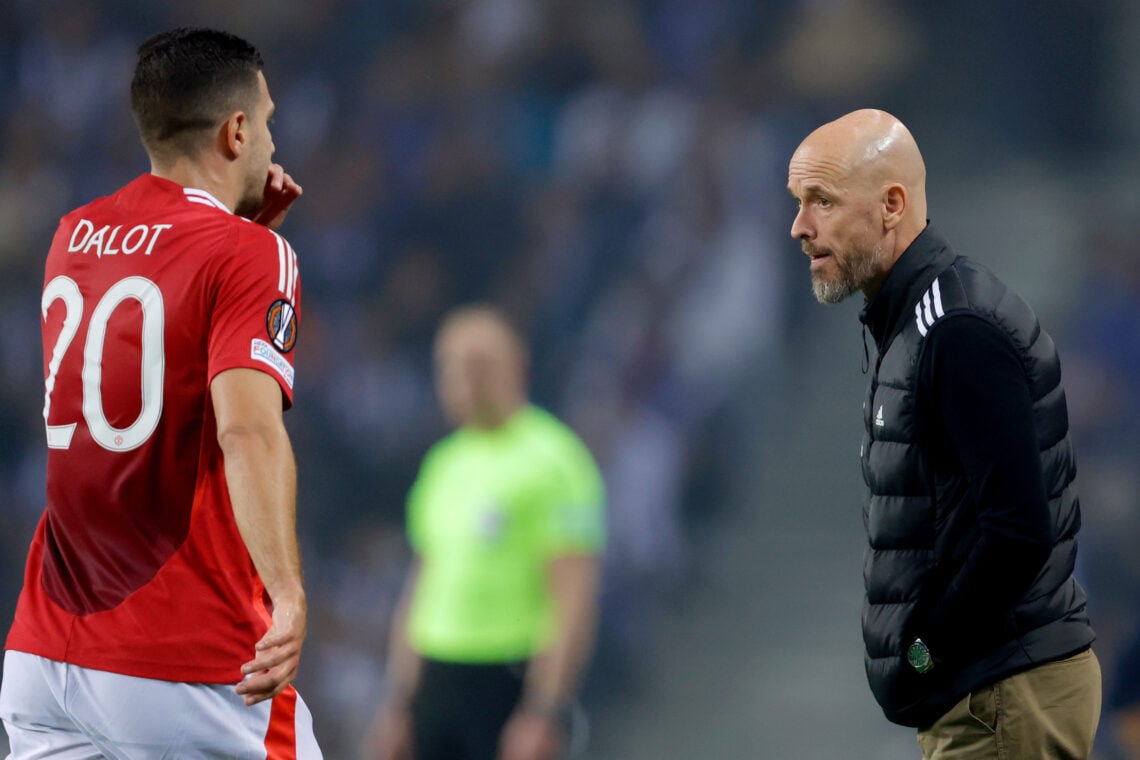


Diogo Dalot was one of Ruben Amorim’s most loyal soldiers, but an insight into his role under Erik ten Hag, from the man himself, paints Amorim in a poor light.
The list of errors Ruben Amorim made at Manchester United is already pretty long, and it seems like every game adds another with the benefit of hindsight.
Kobbie Mainoo is the big one, but Bruno Fernandes, Matheus Cunha, Benjamin Sesko, and Patrick Dorgu, before his injury, played better after he left.
Diogo Dalot wasn’t expected to be a name on this list, but he’s improved under Michael Carrick as well, and an insight into that change has been provided by the full-back now.
What are the biggest POSITIVES about Diogo Dalot’s game?

Diogo Dalot’s role under Erik ten Hag
When Ten Hag came to Old Trafford, he had to make a choice, and it was one that Ole Gunnar Solskjaer had no hesitation in making.
Aaron Wan-Bissaka was the marquee right-back option trusted by the Norwegian, while Diogo Dalot had a loan with Milan in Italy, but never really became the preferred option at United.
However, by the end of his second season, Dalot was the Players’ Player of the Year as United salvaged a poor season by beating Man City in the FA Cup final.
Dalot was transformed under Ten Hag, and the secret to that transformation lay in the Dutchman unlocking him as a ball-progressor.
Dalot said on Rio Ferdinand Presents: “Ten Hag saw in me qualities with the ball that no other manager did. On goal kicks, I was going to be a six [defensive midfielder].
“I was training bounce passes and turn under pressing to find Bruno in the 10 [attacking midfield]. I already knew I was able to do it, the buildup. In the first phase, I was a six. I was doing a lot of movements inside. It was important for me to feel that confidence [from Ten Hag that I could do it].”
Ruben Amorim misprofiled Dalot completely
It’s clear from listening to Dalot that he’s more of a ball-progressor, build-up savant, inverted full-back type of player.
Should Manchester United have sacked Ruben Amorim earlier this season?
Could we really have been title contenders?

Amorim, however, forced him to be the polar opposite of that profile, setting him up as a bombing wing-back who found himself at the end of most chances in the final third.
Needless to say, Dalot was often found lacking in that cutting edge, and it’s no surprise considering what he thinks his strengths are.
Dalot got vilified for missing chances he shouldn’t have been at the end of to begin with, and that’s down to Amorim misprofiling.
He would have been a great wide centre-back in Amorim’s setup, or even as a backup to Casemiro in defensive midfield, but only as an emergency solution.
What he wasn’t meant to be is a poor man’s version of Geovany Quenda, a winger-turned-full-back under Amorim at Sporting.
He lacked the offensive repertoire to perform that role, and his right-footedness meant he always had to overlap and take far-post shots at odd angles.
Even Amorim’s loyal soldier was held back by his system.
Receive a digest of our best United content each week direct to your mailbox