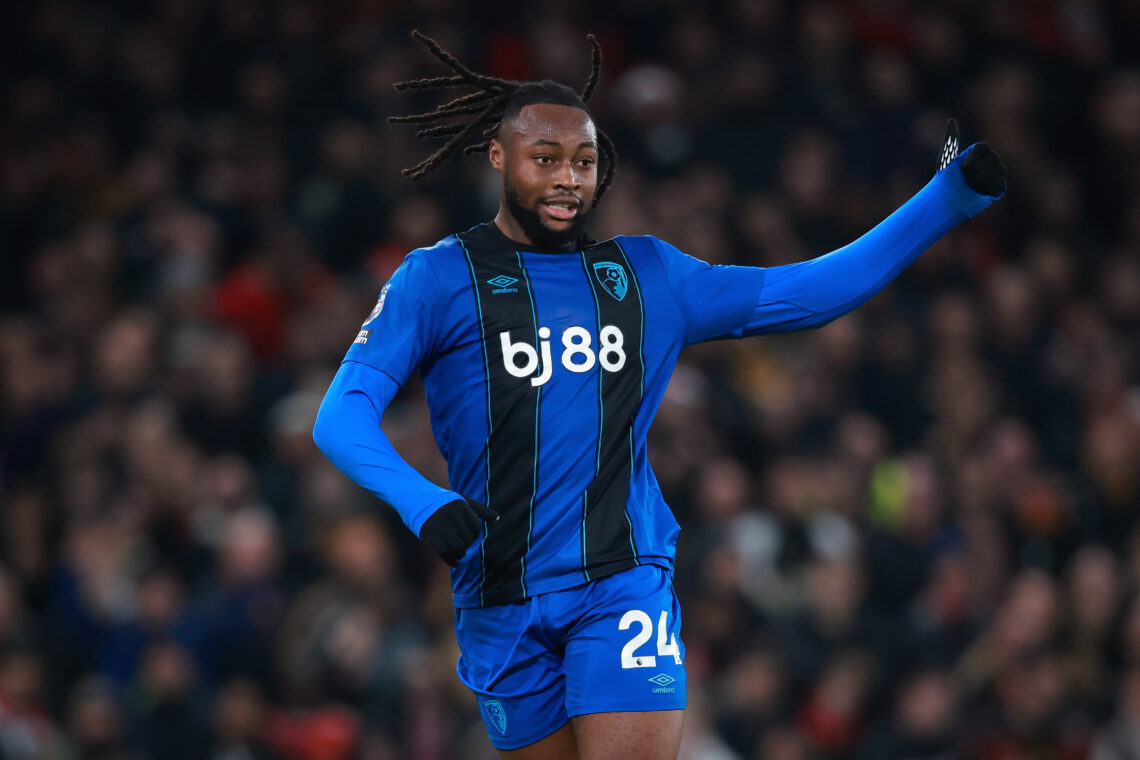


Manchester United fans have been treated to a brilliant Antoine Semenyo update, but it comes with a £450m question that will need answering soon.
Ruben Amorim has called Antoine Semenyo “special” in public, and since then, the player has netted against Man Utd and made his priorities clear.
Semenyo has rejected Spurs’ advances, which leaves the path open for a Manchester derby for his signature, with Liverpool a wild card.
Antoine Semenyo is deciding between Man Utd and Man City
He has REJECTED Tottenham – are you confident he will choose to sign for United?

The release clause worth £65m makes him an enticing addition, as Amorim hinted at himself, but for United, it comes with a £450m cloud.

The finances of Antoine Semenyo’s potential Man Utd transfer
On paper, at first glance, the finances of Semenyo’s move are as straightforward as they can possibly be.
Much like Matheus Cunha, the only negotiating to be done with Bournemouth is how the release clause gets paid, instead of how much is paid.
The clause is active until January 10 only, so a decision is expected soon, and United have clearly positioned themselves in the chase.
United in Focus spoke to GRV Media’s Head of Football Finance and Governance, Adam Williams, who broke down United’s position, which is made tricky due to a £450m cloud hanging over their balance sheet.
He said: “With the way United have approached release clauses, transfer debt and instalment structures in recent years, it hammers home the point that the regime is banking on the recruitment coming good in the next two or three years.
“Their transfer debt is absolutely enormous. Per their last accounts, United owed other clubs just shy of £450m, rising further after last summer’s spending. They were owed about £100m, so on a net basis, they are the league’s biggest spenders on transfer instalments.
Should Man Utd pay Antoine Semenyo’s £65m release clause in January?

“Every club uses instalments as a means for paying for new signings. However, United are an extreme case. When your transfer debt is so consistently large, it becomes a problem.
“The details of Semenyo’s release clause are a little unusual. I haven’t heard of a clause expiring 10 days into January before. The rationale does make sense in terms of giving time for Bournemouth to find a replacement.
“Usually, release clauses are structured so that the buying club has to pay upfront, but there is often some flexibility here. United, for example, reportedly paid slightly more than Zirkzee’s release clause to Bologna, but they got more favourable payment terms in exchange.
“Alternatively, you can go through an invoice discounting facility. Basically, a third party covers the upfront costs and then you pay them back with, say, five per cent interest over five years, for example. So even though City are more replete with cash right now, that shouldn’t necessarily put United at a disadvantage.
“Again, though, I return to the fact that you need to start delivering results when you are this highly-leveraged in terms of transfer debt.”
Sir Jim Ratcliffe is chasing a virtuous cycle at Man Utd
It’s clear from the analysis above that Sir Jim Ratcliffe’s mantra is to cut costs everywhere else while continuing to invest in the men’s first team.
Ultimately, their success on the pitch is the only way to get out of the financial mess that the club was mired in due to the Glazers’ apathy and mismanagement.
In that sense, it is logical to go hard on improving the first team in the hope that they will give you returns on the pitch by qualifying for Europe, and flourishing in the league.
Semenyo’s signing is seen as a piece of that puzzle that eventually gets United up there, and it’s a risky gamble, because if he arrives, United will have spent close to £300m on players in a season where they had no European football.
At some point, the return on investment will cross the “desired” territory into “needed”, which is when the players and the managers will be under pressure.
Currently, the can is being kicked down the road, hoping that by the time it needs to be picked up, United will have plenty more cans to just keep walking.
Receive a digest of our best United content each week direct to your mailbox