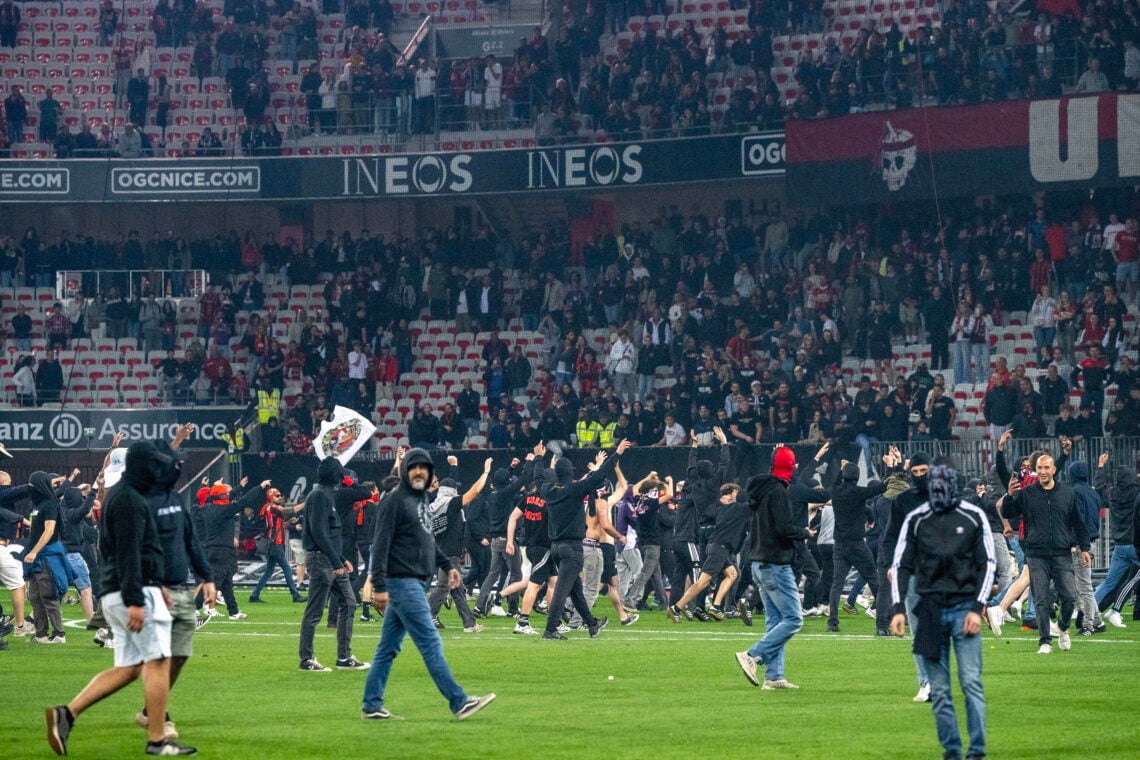


While Sir Jim Ratcliffe’s Manchester United have nothing left to play for this season, the opposite is true at his French football club, OGC Nice, who are approaching among the most significant weeks in their history.
On the final day of the Ligue 1 season, Nice failed to climb out of 16th place, their goalless draw against Metz coupled with results elsewhere consigning them to a two-legged relegation play-off against Saint-Etienne across Tuesday and Friday next week.
Just a few days earlier, however, Claude Puel’s side face Lens in the Coupe de France final in Paris. Win that and – whether they are in Ligue or Ligue 2 – they will play in the Europa League next season.
The stakes – financial, emotional and sporting – could hardly be higher at the end of a wildly turbulent season on the French Riviera.
Manchester United’s multi-club network
Should Ineos be making better use of United's sister clubs? 🤔

Meanwhile, Ineos, whose ownership has been the subject of mass revolt among the ultras in Nice this season, are still trying to sell the club. And with so much on the line before the end of May, Sir Jim Ratcliffe’s football empire is approaching an inflection point.
Here, United in Focus examines the potential impact on Nice, Manchester United and Ineos as a whole.
How OGC Nice relegation could squeeze Man United
It is almost exactly a year since Ratcliffe put Nice up for sale, enlisting the New York investment Lazard to market the club for an asking price of around £215m, more than double the sum he paid to buy them in 2019, though still only a fraction of the £4.5bn valuation implied by his part-takeover of United.
At the time, every expert canvassed by United in Focus said a £215m valuation was blindly optimistic given that Ratcliffe has plunged about £185m into the club since 2019 and qualified for Europe several times but still lost money.
Sure enough, Ineos have since slashed their asking price twice, according to reports. Some sources say that the chemicals multinational would even consider a deal worth about £45m, pricing in the club’s debt.
That number, however, will flex depending on which competitions – domestic and European – Nice play in next season.
Nice were pitiful in the Europa League this season but still picked up around £9m in prize money, which after the collapse of the Ligue 1 TV deal will represent a huge chunk of the club’s total revenue.

Unlike the Premier League meanwhile, Ligue 1 does not have a major parachute payment scheme, meaning relegation could mean Nice’s media income next season falls to around £2m, about one-sixth of what they will earn this season. Set against a wage bill estimated at around £46m annually – built for a club competing in European football – the arithmetic is brutal.
Clearly, Ratcliffe’s attentions are focused squarely on Manchester, where Old Trafford will play host to Champions League football next term thanks to Michael Carrick’s remarkable rescue job in 2026. But unless he is able to divest his interests in Nice, he will be forced to pick up the shortfall there next season, and at a time when his wider business is struggling.
Between them, Ineos’ three main shareholders Ratcliffe, Andrew Currie and John Reece lost an estimated £3bn in wealth in the last 12 months. That decline was mainly linked to the company’s £18bn debts, which in turn are linked to what Ratcliffe describes as a “crisis” in Europe’s energy industry.
Even with Champions League football next term, it is likely that United will need to approve a number of high-value player sales before they can spend big in the summer. The alternative is to seek further external investment from Ratcliffe, which – given that he has injected nearly £250m since the February 2024 part-takeover – is a situation Ineos would dearly like to avoid.
Clearly, every pound or euro that Ratcliffe spends to underwrite losses at Nice is a pound or euro that he would be unable to divert to Old Trafford. His liabilities in France could also weaken his position as United look to secure funding for a new 100,000-seater stadium.
United now plan for the new stadium to be ready for 2035 – What do you think about this?

Survival in Ligue 1 and European football next season could be the difference between Ratcliffe getting a modest fee for the club or effectively giving it away for free in order to avoid footing the bill in 2026-27 and beyond. In the words of Kieran Maguire, speaking to United in Focus earlier this year, that could have a real, material impact for an Ineos who are “asset-rich but cash-poor.”
And while events on the French Riviera over the next couple of weeks won’t directly impact the Red Devils in the short term, the medium to long-term picture could be significant.
Receive a digest of our best United content each week direct to your mailbox