

Football clubs have never been profitable. Despite being one of the game’s biggest brands and earning nearly £10bn in revenue since the turn of the millennium, Manchester United are no exception.
In fact, the bigger the club, the more money it tends to lose. Since United won the treble in 1998-99, they have run up a deficit of almost £500m. And that number is going to increase – fast.
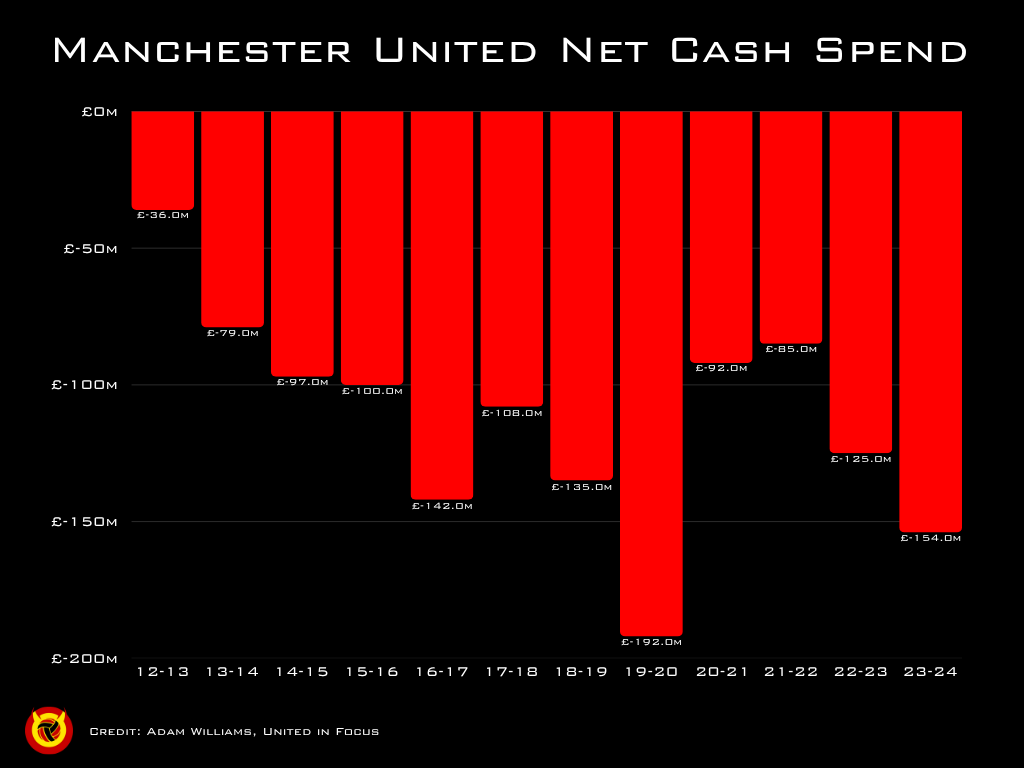
In 2023-24, the last financial year for which a full data set is available, United’s net cash spend was £154m in the red. For every £1 the club earned, they spent around £1.25.
The excess would be more comprehensible if Manchester United were building towards something, but they finished 8th in the Premier League that season and, after an unlikely FA Cup triumph persuaded them to stick with Erik ten Hag, have plumbed new depths thereafter. Under Ruben Amorim, they ended 2024-25 in 15th place and with no European football.
The extra cash needs to be sourced from somewhere. For United, it has historically been through debt, which comes with an interest burden and, as we are currently witnessing, leads to further cash burn. In turn, that limits the funds available in the transfer market.
Since Sir Jim Ratcliffe and Ineos pitched up at Old Trafford, the new co-owners have also injected £328m in cash to cover costs.

Including their initial purchase price of around £1.25bn, that means Ratcliffe is somewhere in the region of £1.5bn in the hole since acquiring a quarter of United in February 2024.
The club is a money pit.
- READ MORE: How much Paul Pogba is earning at Monaco compared to his final Manchester United contract
Man United still valued at nearly £5bn despite cash problems
Why, then, do all the brightest analysts in football finance continue to value Man United at around the £5bn mark?
Take a look at the Glazer family’s other blue-chip sports investment, the NFL franchise Tampa Bay Buccaneers.
In the last financial year, the Bucs generated almost £100m in profit. They have owned the franchise since 1995 and the surpluses the asset has generated in that time have led to eye-watering dividend pay-outs. The two-times Super Bowl champions are, in stark contrast to Man United, a cash machine.

Yes, the Glazers have taken dividends at Old Trafford. To be precise, £166m of dividends. But with the club now generating losses year after year, the dividends have been exhausted. On top of that, £1-2bn is needed to build a new 100,000-seater stadium, which will at least partly be covered by the owners as well as via debt funding.
So where are the analysts getting that £5bn valuation from? And why should you care? Because, in essence, it’s a bet on United’s future – on and off the pitch.
Raine Group: Sir Jim Ratcliffe’s investment can generate profit in 5-10 years
The bet that analysts and investors are making is that clubs can, one day, become consistently profitable.
Ratcliffe’s investment in Man United is part passion project, part capital appreciation scheme. In layman’s terms, he thinks he can increase the value of the club and, one day, sell it on for a profit.
| Rank | Club | Value | Revenue (23-24) |
| 1 | Real Madrid | $6.53 billion | $1.13 billion |
| 2 | Manchester United | $6.09 billion | $834 million |
| 3 | FC Barcelona | $5.71 billion | $802 million |
| 4 | Liverpool | $5.59 billion | $773 million |
| 5 | Bayern Munich | $5.21 billion | $827 million |
| 6 | Manchester City | $5.16 billion | $901 million |
| 7 | Arsenal | $4.49 billion | $773 million |
| 8 | Paris Saint-Germain | $4.26 billion | $873 million |
| 9 | Tottenham Hotspur | $3.68 billion | $652 million |
| 10 | Chelsea | $3.57 billion | $590 million |
To get to that stage, the Red Devils need to outline the pathway to day-to-day profitability. If anyone is qualified to say when and how United can get there, it’s Jason Schretter of Raine Group.
Raine Group banked around £25m for brokering Ratcliffe’s deal to buy around 27 per cent of Man United from the Glazers. They also oversaw the Chelsea takeover in May 2022 and are currently facilitating John Textor’s sale of 43 per cent of Crystal Palace to NFL supremo Woody Johnson.
“I disagree with the view that there is no path to profitability,” Jason Schretter, a partner at Raine Group, recently told the Sportspro Live summit when quizzed about United’s financial losses.
“Several [clubs] are profitable. You need to manage them properly. I think there’s a lot of Premier League clubs that are poorly managed that could use some efficiency gains, a DOGE [Department of Government Efficiency] team to come in and do some fixing.
“What are bigger brands in the world than those teams that are worth billions and what are those other brands worth in parallel? These are archetypes of the culture.
“I think over the course of the next five, ten years, you’re going to see a lot more that these [teams] can do.”
TV and streaming revolution will lead United to profit again, says Kieran Maguire
But where is the profit coming from?
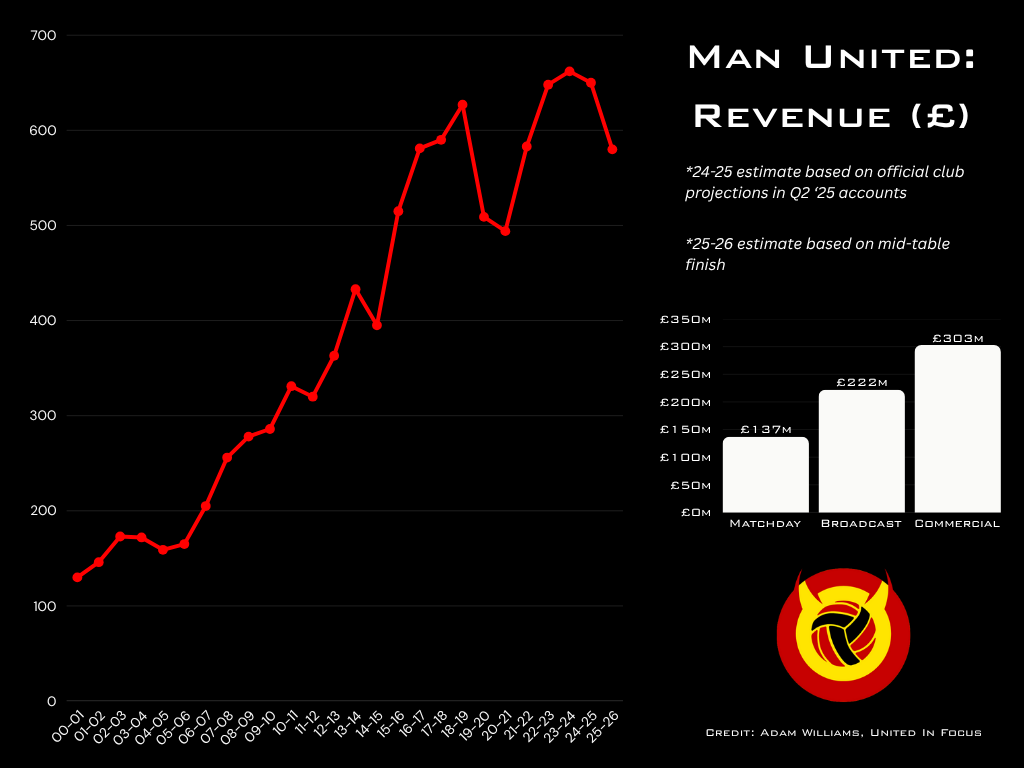
Manchester United have three primary revenue streams:
- Media – Premier League, UEFA and FA streaming and TV cash, paid out as prize money
- Matchday – General admission, food and drink, hospitality sales
- Commercial – Sponsorship, retail, events
To generate a profit, United either need to dramatically cut costs or increase revenue.
According to University of Liverpool football finance lecturer Kieran Maguire, a revolution in the way United fans consume coverage of their team is likely the golden goose.
“In a business environment where your largest revenue stream – broadcasting – is certainly past peak growth, the picture is increasingly challenging,” said the Price of Football author in exclusive conversation with United in Focus.
“Media revenue is flatlining in the domestic market, and there’s limited growth overseas. Disruption in the broadcast market is coming.
The latest iteration of the Premier League’s TV deal, which remains United’s single biggest individual source of revenue, is worth over £13bn. That’s a hike on the previous deal but, on a per-match basis, is actually less lucrative for the Red Devils and their peers.
| Category | Value | Duration | P/a |
| Domestic (UK) | £6.7 billion | 4 years (2025–2029) | ~£1.675 billion |
| International | ~£6.5 billion (est.) | 3 years (2025–2028) | ~£2.17 billion |
| Total Combined | ~£13.2 billion | — | ~£3.84 billion |
To arrest slowing growth, Maguire suggests, a new streaming product such as a direct-to-consumer platform with more interactive features could be the answer.
“Among the investment community, there’s a view that alternative ways of consuming football haven’t yet been realised – not because of lack of demand, but because the technology hasn’t yet justified the price points needed.
“As that technology develops – particularly ways to involve fans more deeply in the live experience – pay-per-view models could be a game-changer for Manchester United in terms of revenue.”
“Looking at the three pillars of revenue – broadcasting, matchday, and commercial – traditional broadcasting is at its peak. Commercial is growing roughly in line with GDP. That means the focus has to shift to alternatives within the broadcast space, especially in international markets.
United must cut costs too, but PSR isn’t working
Soaring revenues mean nothing if your costs are rising faster, however.
This has been an era-defining issue for Man United, as well as the wider Premier League ecosystem.

The aim of both UEFA’s Financial Fair Play (FFP) and the Premier League’s Profit and Sustainability Rules (PSR) was to create natural spending limits that would help clubs become profitable and more investable
But instead, the rules have acted as more of a floor than a ceiling, with clubs locked in an inflationary spiral in both the wage and transfer market.
“United may struggle with cost control because ownership groups in the Premier League are fragmented, with different objectives,” says Maguire.
“You have groups like FSG focused on profit maximisation, not just revenue. At the other end, there are clubs prioritising success on the pitch and global influence over short-term financial returns.
“Finding a compromise between these opposing approaches is going to be very difficult.”
Receive a digest of our best United content each week direct to your mailbox